ChemGem

How to Choose the Right Gas Law (Step-by-Step, with Practice)

Gas particles hitting the walls make pressure. Read what stays fixed, predict the direction, then pick the law.

Spot it, solve it, practice it: 4 steps, 1 worked example, 10 practice problems. Free, no account.

The route · 4 steps

  1. Identify what stays constant.
  2. Predict the direction: will the unknown go up or down?
  3. Convert temperature to kelvin and match units.
  4. Solve the matching law and check against your prediction.
Spot it

How to recognize gas law questions

Look for a gas changing from one state to another, with words like "at fixed temperature," "rigid," or "sealed" telling you what stays constant.

Example wording, with the clue words marked:

A gas at 2.0 atm occupies 9.0 L. At fixed temperature and amount, volume becomes 18.0 L. What is pressure?

Not sure it’s this type? Compare the neighbors:

Step-by-step

Worked example: gas law

The idea

Fixed gas amount: P × V ÷ T stays equal
P1 × V1T1 = P2 × V2T2
P pressure, V volume, T in kelvin. Use when P, V and T all change. Match units on both sides.
Read what stays fixed, then choose the law
LawHeld fixedEquationDirection
Boyle’s lawT and nP1V1 = P2V2V up → P down
Charles’s lawP and nV1T1 = V2T2T up → V up
Gay-Lussac’s lawV and nP1T1 = P2T2T up → P up
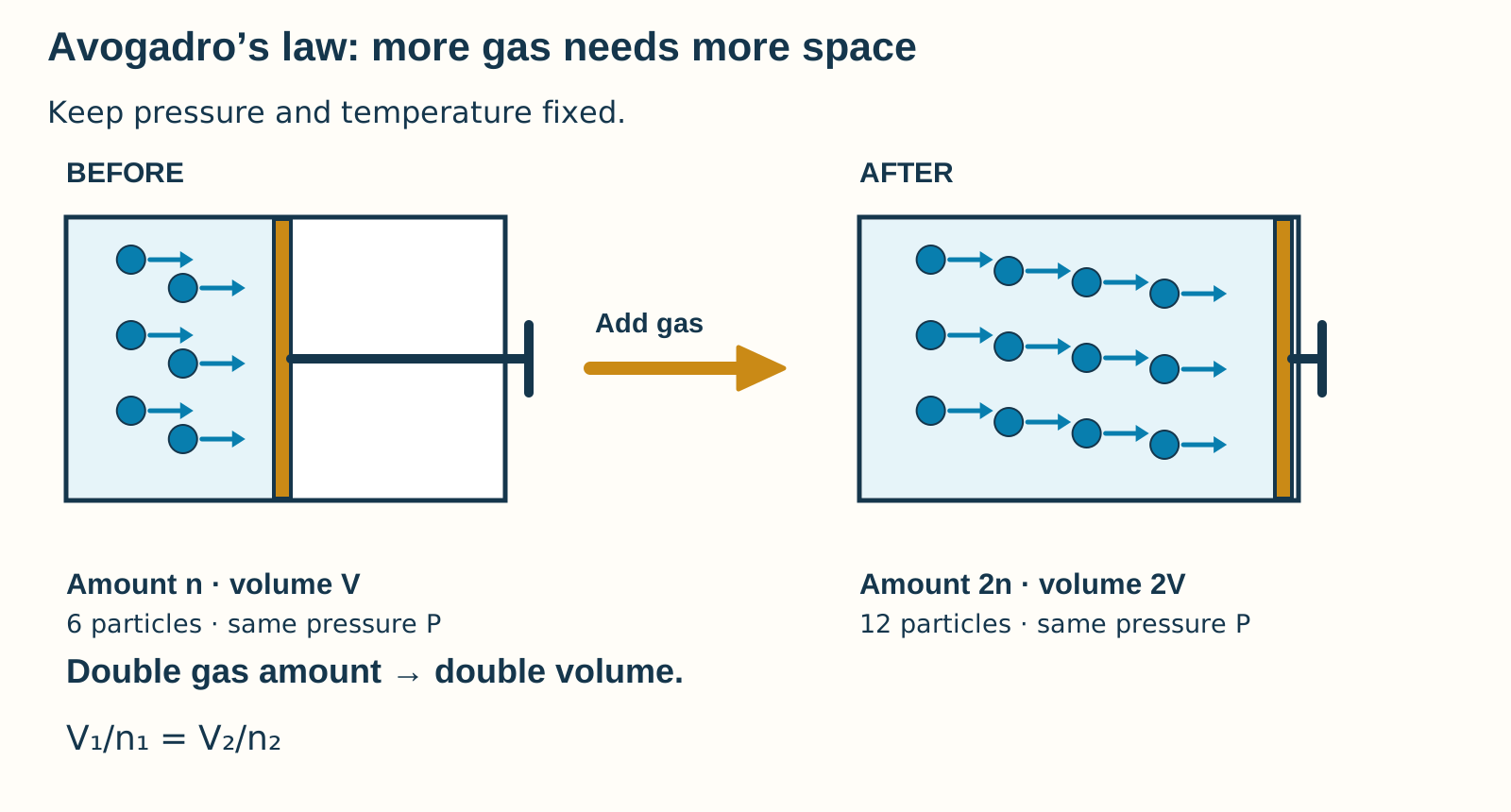
Avogadro’s lawP and TV1n1 = V2n2n up → V up
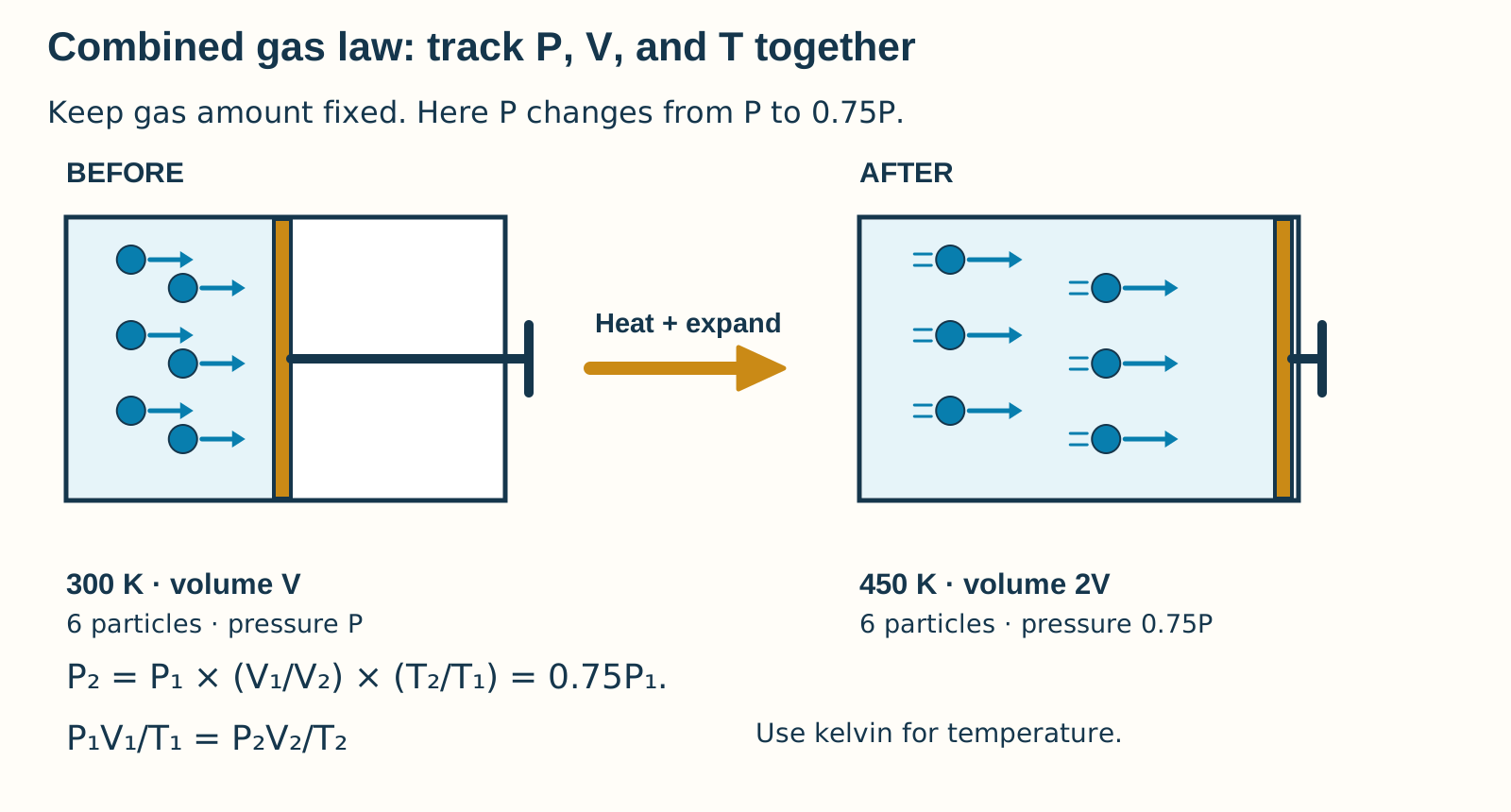
Combined gas lawn onlyP1V1T1 = P2V2T2track all three
n is the amount of gas in moles.
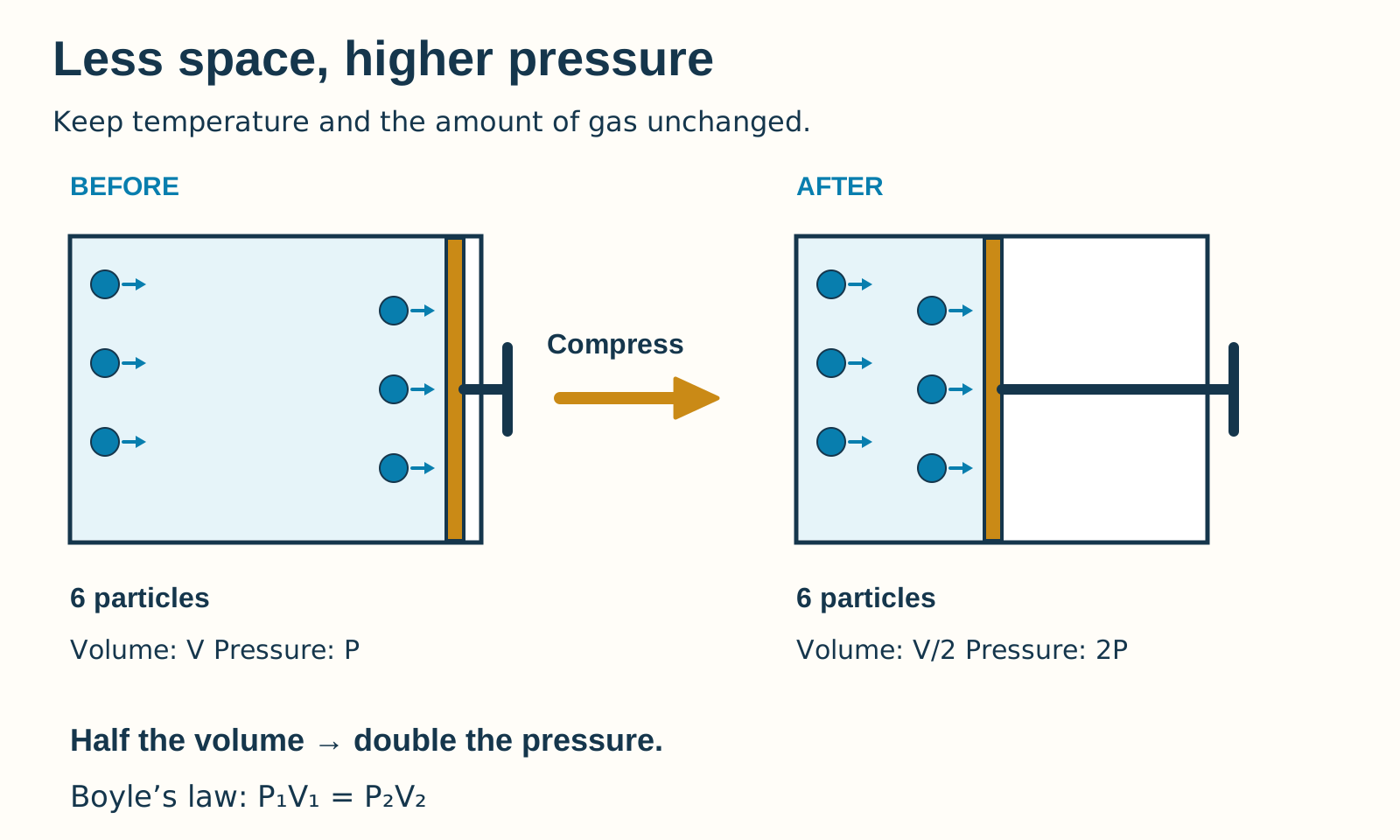
Gas compresses from V at P to V/2 at 2P. Same six particles and fixed temperature.
Same six particles, same speed, half the space: more wall hits, double the pressure.
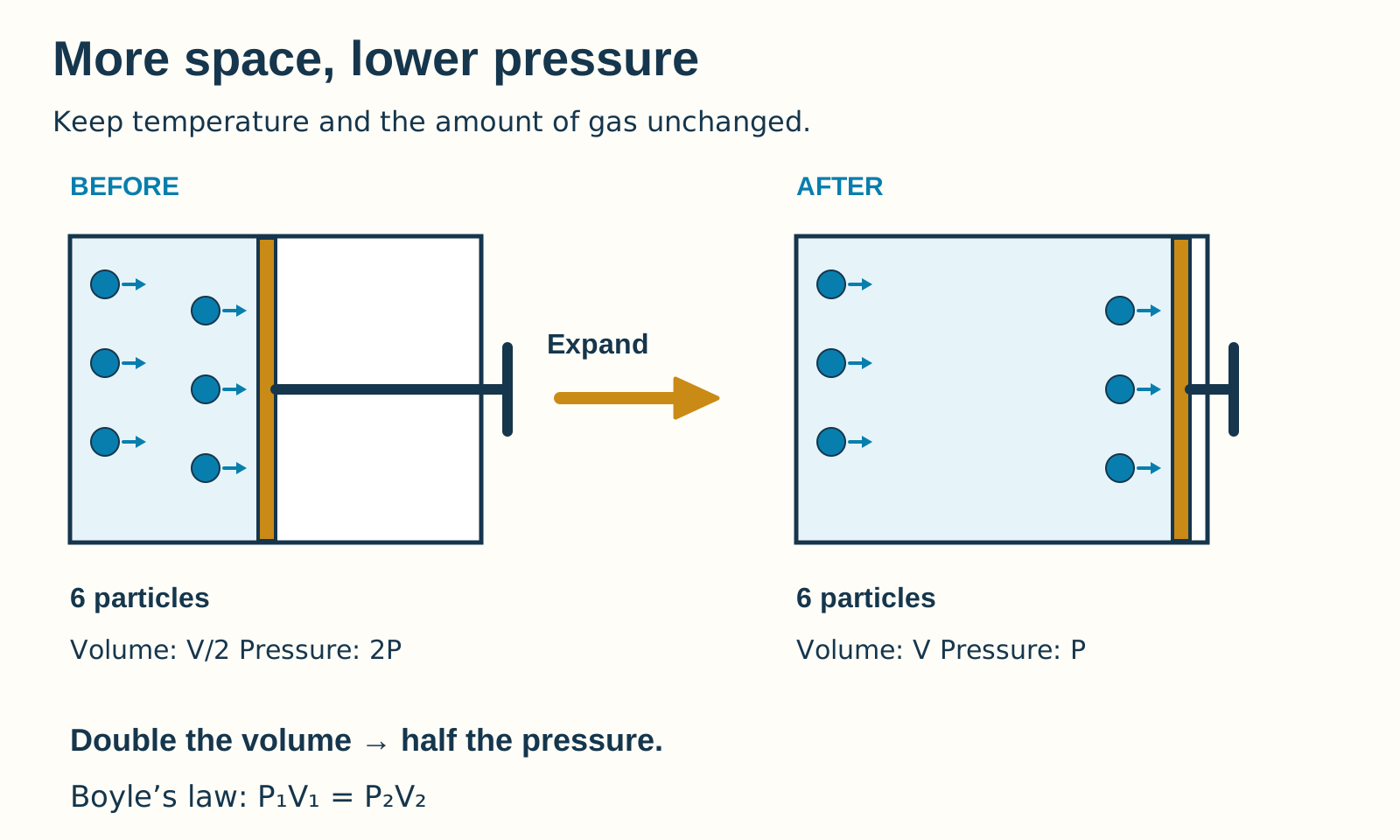
Gas expands from V/2 at 2P to V at P. Same six particles and fixed temperature.
More space spreads the particles out: fewer wall hits, lower pressure.
Boyle’s law: P × V stays 4.0 L·atm
01234012345678P = 4.0 L·atm ÷ V4.0 L, 1.0 atm2.0 L, 2.0 atmVolume (L)Pressure (atm)
Halve the volume, double the pressure. The curve is the worked example below.
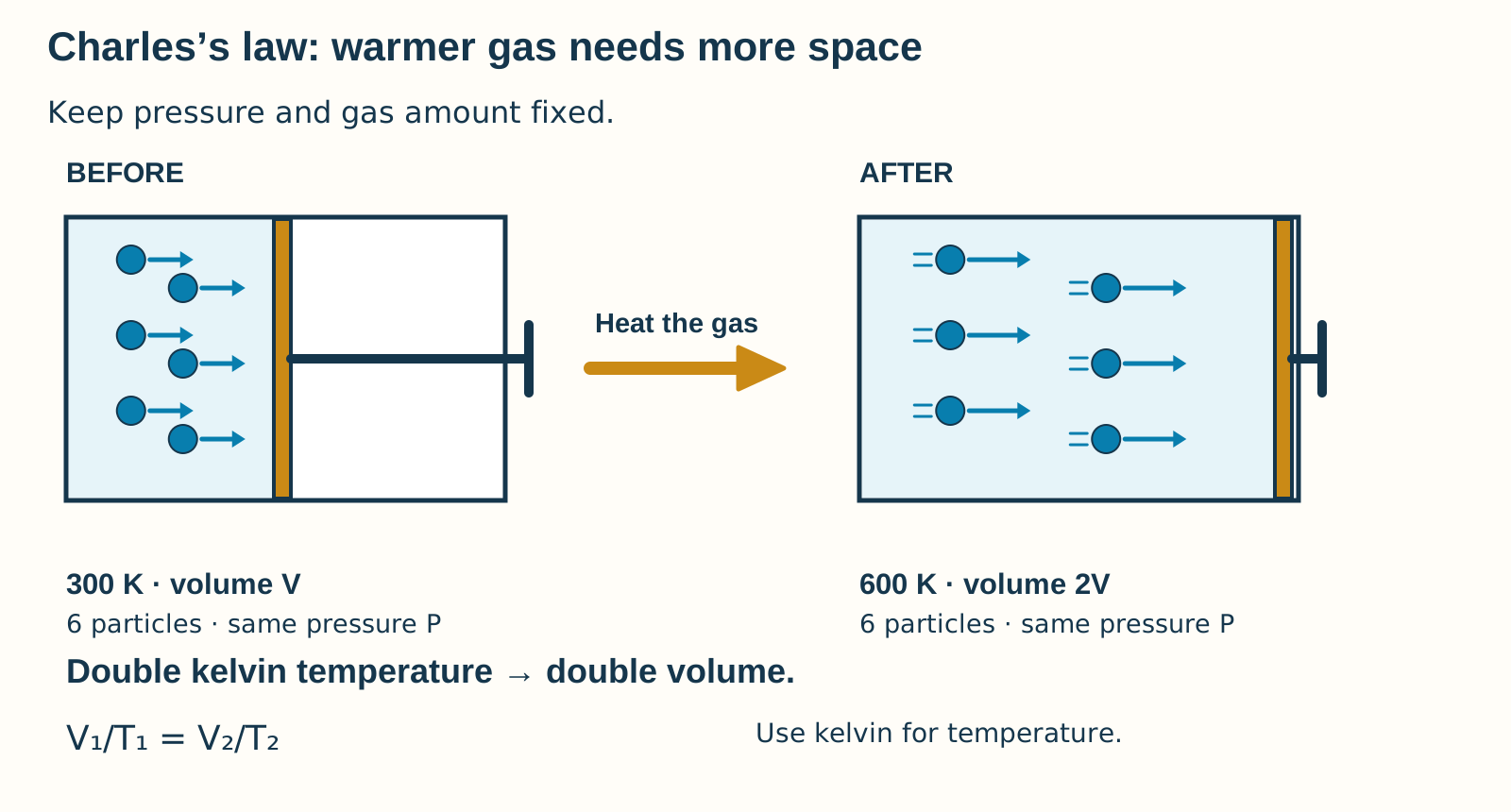
A piston cylinder holds 6 particles at 300 K in volume V. After heating to 600 K at the same pressure P, the piston has moved out to volume 2V and the particles have longer motion arrows.
Fixed P and n: double kelvin T, double V. Schematic ideal-gas model.
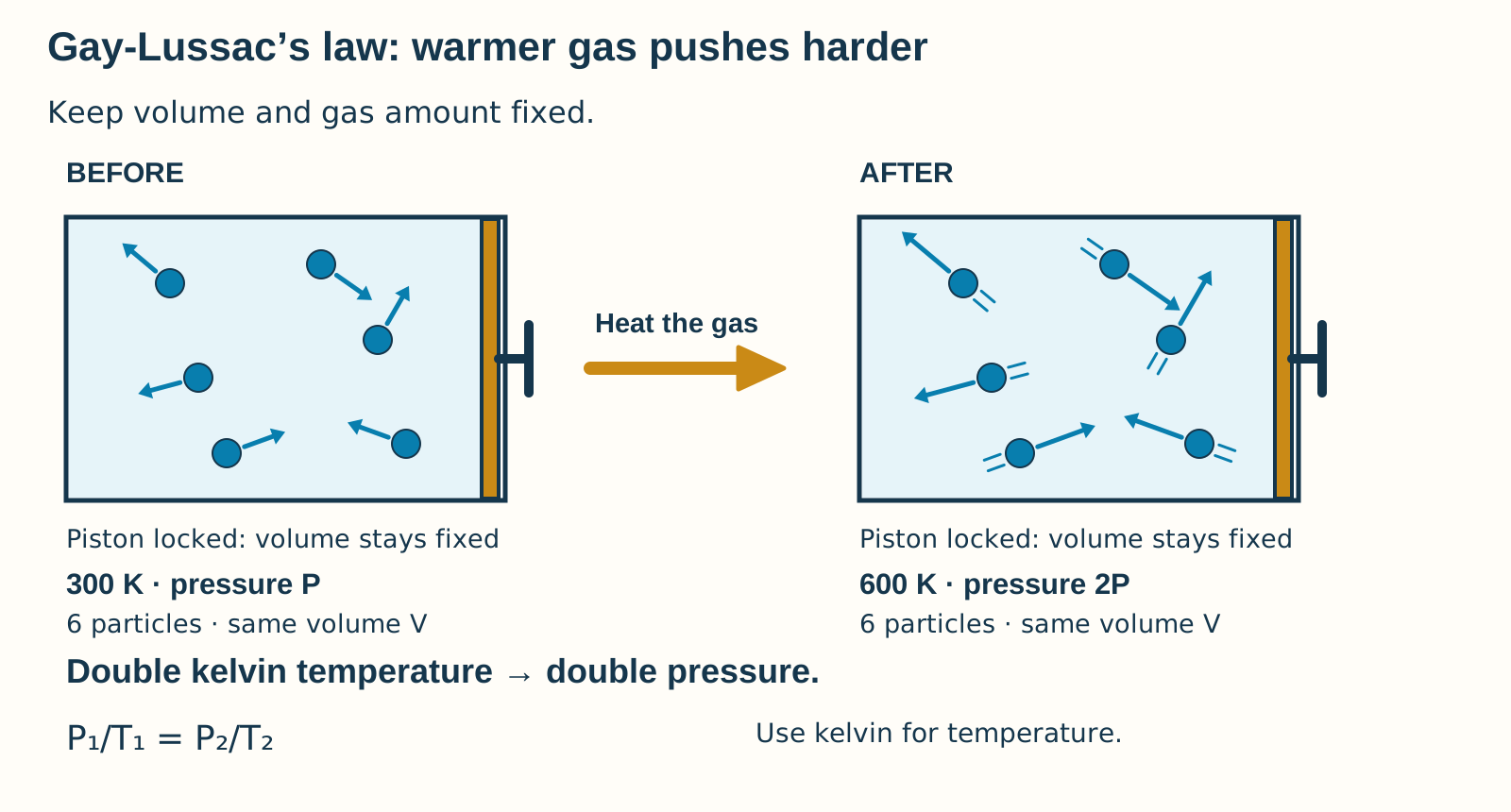
Gay-Lussac’s law: warmer gas pushes harder. Keep volume and gas amount fixed. Double kelvin temperature → double pressure. Motion arrows represent typical speeds; higher temperature means faster average motion. Schematic ideal-gas model.
Fixed V and n: double kelvin T, double P.
Avogadro’s law: more gas needs more space. Keep pressure and temperature fixed. Double gas amount → double volume. Twelve equal gas markers represent twice the amount shown by six; typical speeds stay unchanged. Schematic ideal-gas model.
Fixed P and T: double n, double V. Speeds stay the same.
Combined gas law: track P, V, and T together. Keep gas amount fixed. Here P changes from P to 0.75P. P₂ = P₁ × (V₁/V₂) × (T₂/T₁) = 0.75P₁. Motion arrows represent typical speeds; higher temperature means faster average motion. Schematic ideal-gas model.
Fixed n only: P2 = P1 × (V1/V2) × (T2/T1) = 0.75P1 here.
Why gases behave this way (kinetic-molecular model)
  • Particles are tiny compared with the space between them.
  • They move randomly in straight lines and bounce off each other and the walls.
  • Kelvin temperature is proportional to their average kinetic energy (energy of motion, KE = ½mv2).
  • Hotter means faster particles. They hit the walls harder and more often.
  • So heating raises pressure at fixed volume, or makes the gas expand at fixed pressure.
Convert before you substitute
QuantityConversion
TemperatureK = °C + 273.15
Pressure1 atm = 101.325 kPa = 760 mmHg (torr)
Pressure1 kPa = 1000 Pa
Both pressures in the same unit; both volumes in the same unit.

On the periodic table: On the periodic table, oxygen is atomic number 8, mass 16.00 (an average, not an isotope’s mass number).

On the periodic table: O2 is two O atoms per molecule; it stays oxygen when compressed.

On the periodic table: The fixed conditions, not periodic-table position, choose the law. Use supplied masses when given.

Worked example · 4 steps

A gas occupies 4.0 L at 1.0 atm. At fixed temperature and amount, it is compressed to 2.0 L. Find the pressure.

  1. 1
    Identify what stays fixed

    T and n are fixed: Boyle’s law. No molar mass needed.

    PressureVolume
    Start (1)1.0 atm4.0 L
    End (2)?2.0 L
    Fixed: T and n → P1V1 = P2V2
  2. 2
    Predict the direction

    The same particles get half the space, so pressure must rise.

    V: 4.0 L → 2.0 L (halved)  ⇒  P goes up
  3. 3
    Solve for final pressure

    Divide the starting pressure-volume product by the final volume.

    P1V1 = P2V2  ⇒  P2 = P1V1V2
  4. 4
    Calculate

    Liters cancel, leaving atm. Halving the volume doubles the pressure.

    P2 = (1.0 atm)(4.0 L)2.0 L = 2.0 atm
  5. ✓
    Answer

    P2 = 2.0 atm

Your turn

Gas law practice problems

Answer first, then check. Hints open one at a time; the answer and full solution open after you try.

Problem 1 of 10 · warm-up

A gas at 2.0 atm occupies 9.0 L. At fixed temperature and amount, volume becomes 18.0 L. What is pressure?

Hint 1 · the clue

Temperature and amount are fixed while volume changes.

Hint 2 · the next move

"At fixed temperature and amount" with pressure and volume changing signals Boyle's law: P1V1 = P2V2.

Your path:

  1. Fixed T and n → Boyle's law
  2. Rearrange: P2 = P1V1 ÷ V2
  3. Volume up means pressure down
Answer

Answer: 1.0 atm

Full worked solution

What you know: P1 = 2.0 atm, V1 = 9.0 L, V2 = 18.0 L; T and n fixed. What you want: P2.

  1. Fixed T and n means Boyle’s law: P1V1 = P2V2.
  2. Divide both sides by V2: P2 = P1V1 ÷ V2.
  3. Substitute: P2 = 2.0 atm × 9.0 L ÷ 18.0 L. The L units cancel. 9.0 ÷ 18.0 = 0.500, so P2 = 2.0 atm × 0.500 = 1.0 atm.

Check: Volume doubled, so pressure should halve. Half of 2.0 atm is 1.0 atm.

Your route: Fixed T and n → P1V1 = P2V2.

Answer: 1.0 atm

Problem 2 of 10

A gas at 2.0 atm occupies 10.0 L. At fixed temperature and amount, volume becomes 20.0 L. What is pressure?

Hint 1 · the clue

Temperature and amount are fixed while volume changes.

Hint 2 · the next move

"At fixed temperature and amount" with pressure and volume changing signals Boyle's law: P1V1 = P2V2.

Your path:

  1. Fixed T and n → Boyle's law
  2. Rearrange: P2 = P1V1 ÷ V2
  3. Volume up means pressure down
Answer

Answer: 1.0 atm

Full worked solution

What you know: P1 = 2.0 atm, V1 = 10.0 L, V2 = 20.0 L; T and n fixed. What you want: P2.

  1. Fixed T and n means Boyle’s law: P1V1 = P2V2.
  2. Divide both sides by V2: P2 = P1V1 ÷ V2.
  3. Substitute: P2 = 2.0 atm × 10.0 L ÷ 20.0 L = 20 atm·L ÷ 20.0 L = 1.0 atm. The L units cancel.

Check: Volume doubled, so pressure halves. Bigger volume, lower pressure, as Boyle’s law predicts.

Your route: Fixed T and n → P1V1 = P2V2.

Answer: 1.0 atm

Problem 3 of 10

At fixed pressure and amount, a gas volume is 9.00 L at 300 K. What is volume at 450 K?

Hint 1 · the clue

Temperature changes at fixed pressure and amount.

Hint 2 · the next move

"At fixed pressure and amount" with volume and kelvin temperature changing signals Charles's law: V1/T1 = V2/T2.

Your path:

  1. Fixed P and n → Charles's law
  2. Confirm temperatures are in kelvin
  3. Rearrange: V2 = V1 × T2/T1
Answer

Answer: 13.5 L

Full worked solution

What you know: V1 = 9.00 L, T1 = 300 K, T2 = 450 K; P and n fixed. What you want: V2.

  1. Fixed P and n means Charles’s law: V1/T1 = V2/T2. Both temperatures are already in kelvin.
  2. Multiply both sides by T2: V2 = V1 × T2/T1.
  3. Substitute: V2 = 9.00 L × 450 K/300 K = 9.00 L × 1.5 = 13.5 L. The K units cancel.

Check: Temperature rose, so volume should grow. 13.5 L is more than 9.00 L.

Watch out: Put the new temperature on top. Using 300/450 would shrink the volume, the wrong direction.

Your route: Fixed P and n → V/T constant.

Answer: 13.5 L

Problem 4 of 10

At fixed pressure and amount, a gas volume is 10.0 L at 300 K. What is volume at 450 K?

Hint 1 · the clue

Temperature changes at fixed pressure and amount.

Hint 2 · the next move

"At fixed pressure and amount" with volume and kelvin temperature changing signals Charles's law: V1/T1 = V2/T2.

Your path:

  1. Fixed P and n → Charles's law
  2. Confirm temperatures are in kelvin
  3. Rearrange: V2 = V1 × T2/T1
Answer

Answer: 15.0 L

Full worked solution

What you know: V1 = 10.0 L, T1 = 300 K, T2 = 450 K; P and n fixed. What you want: V2.

  1. Fixed P and n means Charles’s law: V1/T1 = V2/T2. Both temperatures are in kelvin.
  2. Isolate V2: V2 = V1 × T2/T1.
  3. Substitute: V2 = 10.0 L × 450 K/300 K = 10.0 L × 1.5 = 15.0 L. The K units cancel.

Check: The kelvin temperature went up by a factor of 1.5, so the volume does too. Warmer gas takes more space.

Your route: Fixed P and n → V/T constant.

Answer: 15.0 L

Problem 5 of 10

A rigid sealed gas container has pressure 0.80 atm at 200 K. What pressure does it reach at 400 K?

Hint 1 · the clue

A rigid sealed container fixes volume and amount.

Hint 2 · the next move

"Rigid sealed" means volume and amount are fixed, so pressure tracks kelvin temperature: Gay-Lussac's law, P1/T1 = P2/T2.

Your path:

  1. Fixed V and n → Gay-Lussac's law
  2. Rearrange: P2 = P1 × T2/T1
  3. Hotter means higher pressure
Answer

Answer: 1.6 atm

Full worked solution

What you know: P1 = 0.80 atm, T1 = 200 K, T2 = 400 K. A rigid sealed can fixes V and n. What you want: P2.

  1. Fixed V and n means Gay-Lussac’s law: P1/T1 = P2/T2.
  2. Isolate P2: P2 = P1 × T2/T1.
  3. Substitute: P2 = 0.80 atm × 400 K/200 K = 0.80 atm × 2 = 1.6 atm. The K units cancel.

Check: Kelvin temperature doubled, so pressure doubles. Hotter gas in a fixed box pushes harder.

Watch out: Read the clue words. Rigid means the volume cannot change, so this is not Boyle’s or Charles’s law.

Your route: Fixed V and n → P/T constant.

Answer: 1.6 atm

Problem 6 of 10

Before using a gas law, convert 100°C to its absolute temperature. What is the value in kelvin?

Hint 1 · the clue

A gas-law temperature scale is asked.

Hint 2 · the next move

A Celsius temperature and "kelvin" are asked for before a gas law: gas laws need the absolute scale, so add 273.15.

Your path:

  1. Gas laws need kelvin, not °C
  2. Use K = °C + 273.15
Answer

Answer: 373.15 K

Full worked solution

What you know: T = 100°C. What you want: the same temperature in kelvin.

  1. Gas laws need an absolute scale, kelvin. Kelvin starts at absolute zero, so ratios like V/T make sense. Celsius ratios do not.
  2. Use K = °C + 273.15.
  3. Substitute: T = 100 + 273.15 = 373.15 K.

Check: A kelvin value is always 273.15 larger than the Celsius value, and it is never negative.

Watch out: Don’t subtract 273.15. That direction goes from kelvin to Celsius.

Your route: Convert Celsius → Kelvin before gas calculation.

Answer: 373.15 K

Problem 7 of 10

A sealed, rigid can of gas is heated. Explain in terms of particles why its pressure rises.

Hint 1 · the clue

What does a higher temperature do to particle speed?

Hint 2 · the next move

"Sealed, rigid" and "in terms of particles" call for the kinetic-molecular model: heat makes particles move faster.

Your path:

  1. Sealed, rigid: n and V fixed
  2. Heating raises particles' average speed
  3. Faster particles hit walls harder, more often
Answer

Answer: The particles move faster, so they hit the walls harder and more often.

Full worked solution

What you know: the can is sealed (fixed n) and rigid (fixed V), and it is heated. What you want: a particle explanation of the pressure rise.

  1. Kinetic-molecular model: kelvin temperature is proportional to the particles’ average kinetic energy. Heating makes them move faster.
  2. Pressure comes from particles hitting the walls. Faster particles hit harder, and they reach the walls more often.
  3. The volume and the number of particles cannot change, so nothing offsets this. Therefore the particles move faster, so they hit the walls harder and more often, and the pressure rises.

Why it matters: This is the particle picture behind Gay-Lussac’s law: at fixed V and n, P/T stays constant.

Watch out: The particles do not get bigger or multiply. Only their speed changes.

Answer: The particles move faster, so they hit the walls harder and more often.

Problem 8 of 10

3.0 L at 2.0 atm expands to 6.0 L at fixed T and amount. Pressure?

Hint 1 · the clue

Choose the gas relation that matches what stays constant. Use kelvin for temperature, match units, and isolate the requested quantity.

Hint 2 · the next move

"At fixed T and amount" with volume changing signals Boyle's law: pressure and volume change in opposite directions.

Your path:

  1. Fixed T and n → Boyle's law
  2. Rearrange: P2 = P1V1 ÷ V2
  3. Expansion means pressure drops
Answer

P2 = 2.0 × 3.0/6.0 = 1.0 atm.

Full worked solution

What you know: V1 = 3.0 L, P1 = 2.0 atm, V2 = 6.0 L; T and n fixed. What you want: P2.

  1. T and n stay constant, so choose Boyle’s law: P1V1 = P2V2.
  2. Divide both sides by V2: P2 = P1V1 ÷ V2.
  3. Substitute: P2 = 2.0 atm × 3.0 L ÷ 6.0 L = 6.0 atm·L ÷ 6.0 L = 1.0 atm. The L units cancel.

Check: The gas expanded to twice the volume, so the pressure halves: 2.0 → 1.0 atm.

Watch out: Expansion lowers pressure. If your answer went up to 4.0 atm, you flipped the volume ratio.

Answer: P2 = 2.0 × 3.0/6.0 = 1.0 atm.

Problem 9 of 10

A rigid, sealed steel tank of gas is heated from 300 K to 600 K. Using particle motion, explain what happens to the gas pressure, and by what factor it changes.

Hint 1 · the clue

Pressure comes from particles hitting the walls. Ask what doubling the kelvin temperature does to the particles’ speed, then how that changes their wall hits.

Hint 2 · the next move

"Rigid, sealed" tank heated in kelvin, with "particle motion" asked: fixed V and n, so pressure tracks kelvin temperature.

Your path:

  1. Rigid, sealed: V and n fixed
  2. Faster particles hit walls harder, more often
  3. Pressure changes by the kelvin ratio T2/T1
Answer

Pressure doubles to 2× its starting value: faster particles hit the walls harder and more often.

Full worked solution

What you know: Rigid, sealed tank, so V and n are fixed. T rises from 300 K to 600 K. What you want: What happens to pressure, and why, in terms of particle motion.

  1. Kelvin temperature is proportional to the particles’ average kinetic energy. Doubling T from 300 K to 600 K doubles their average kinetic energy, so they move faster.
  2. Faster particles hit the walls more often, and each hit pushes harder. Both effects raise the pressure.
  3. With V and n fixed, use Gay-Lussac’s law: P2/P1 = T2/T1 = 600 K ÷ 300 K = 2. So pressure doubles.

Check: The direction matches the prediction: hotter gas in a fixed space pushes harder on the walls, so pressure goes up, not down.

Watch out: The particles do not get bigger, and there are not more of them. The tank is sealed, so only their speed changes. Also, doubling a Celsius temperature does not double the pressure; the ratio works only in kelvin.

Answer: Pressure doubles to 2× its starting value: faster particles hit the walls harder and more often.

Problem 10 of 10

A fixed amount of gas occupies 2.00 L at 1.00 atm and 27°C. It is compressed to 1.00 L and heated to 177°C. What is the new pressure?

Hint 1 · the clue

Pressure, volume and temperature all change, so use P1V1/T1 = P2V2/T2. Convert both temperatures to kelvin before substituting.

Hint 2 · the next move

A "fixed amount" of gas with pressure, volume, and Celsius temperature all changing signals the combined gas law.

Your path:

  1. Only n fixed → combined gas law
  2. Convert both temperatures to kelvin
  3. Rearrange P1V1/T1 = P2V2/T2 for P2
Answer

P2 = 1.00 × 2.00 × 450.15/(300.15 × 1.00) = 3.00 atm.

Full worked solution

What you know: P1 = 1.00 atm, V1 = 2.00 L, T1 = 27°C; V2 = 1.00 L, T2 = 177°C; n fixed. What you want: P2.

  1. P, V and T all change while n stays fixed, so use the combined gas law: P1V1/T1 = P2V2/T2.
  2. Convert to kelvin: T1 = 27 + 273.15 = 300.15 K and T2 = 177 + 273.15 = 450.15 K.
  3. Isolate P2: P2 = P1V1T2 ÷ (T1V2).
  4. Substitute: P2 = 1.00 atm × 2.00 L × 450.15 K ÷ (300.15 K × 1.00 L). The L and K units cancel. 900.30 ÷ 300.15 = 2.9995, which rounds to three significant figures as 3.00 atm.

Check: Halving the volume doubles the pressure (to 2.00 atm), and raising T by a factor of about 1.5 raises it again: 2.00 × 1.5 = 3.00 atm. Both changes push pressure up, so a larger answer makes sense.

Watch out: Using Celsius gives 1.00 × 2.00 × 177 ÷ (27 × 1.00) = 13.1 atm, which is far too high. Always convert to kelvin first.

Answer: P2 = 1.00 × 2.00 × 450.15/(300.15 × 1.00) = 3.00 atm.

Watch out

Common gas law mistakes