ChemGem

How to Use the Ideal Gas Law (Step-by-Step, with Practice)

PV = nRT (the ideal gas law) links a gas’s pressure, volume, amount and temperature. Know three and you can find the fourth, if the units match R. At STP it gives a handy shortcut: about 22.4 L per mole.

Spot it, solve it, practice it: 5 steps, 1 worked example, 3 practice problems. Free, no account.

The route · 5 steps

  1. Identify the unknown.
  2. Match units to R; convert P, V or mass as needed.
  3. Use kelvin temperature.
  4. Rearrange PV = nRT, substitute and cancel units.
  5. At STP, you may use 22.4 L/mol instead.
Spot it

How to recognize ideal gas law questions

Look for one gas in one state with moles, temperature, pressure, and an R value given, and one of P, V, n, or T asked; or a gas “at STP” (0 °C, 1 atm), where 1 mol fills 22.4 L.

Example wording, with the clue words marked:

Rounded to two decimal places for this arithmetic drill, what is the volume for 1.2 mol ideal gas at 300 K and 1.00 atm? Use R = 0.08206 L·atm/(mol·K).

Not sure it’s this type? Compare the neighbors:

Step-by-step

Worked example: ideal gas law

The idea

The ideal gas equation
P × V = n × R × T
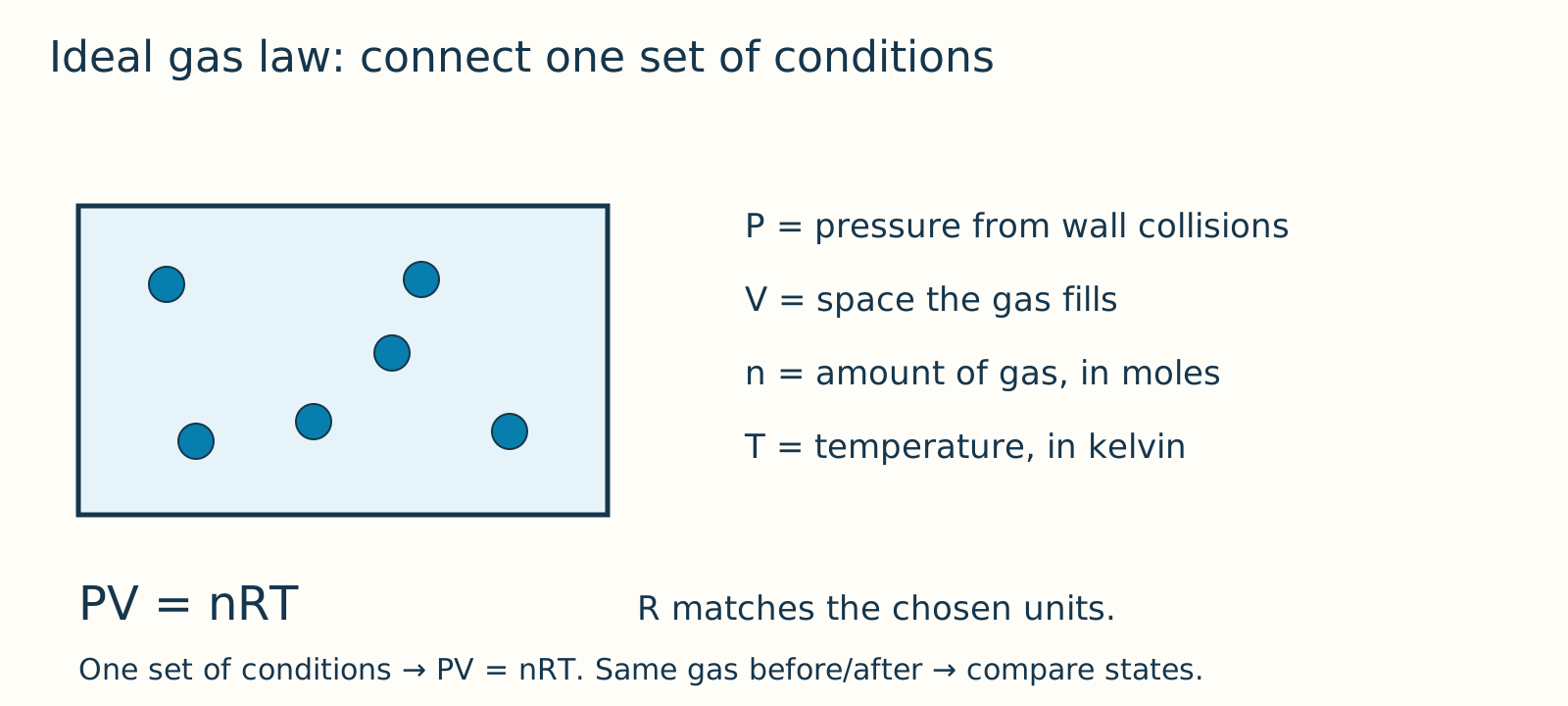
P pressure, V volume, n moles, T temperature in kelvin, R the gas constant.
One gas sample has pressure P, volume V, mole amount n, and kelvin temperature T, linked by PV equals nRT. Six markers illustrate particles, not six moles.
Markers show particles, not six moles.
Choose R to match your units
R valuePressureVolumeAmountTemperature
0.08206 L·atm/(mol·K)atmLmolK
8.314 J/(mol·K)Pam3molK
Use the R your problem supplies.
Conversions to make before you substitute
If you are givenConvert withTo get
°C+ 273.15K
kPa or mmHg1 atm = 101.325 kPa = 760 mmHgatm
mL1 L = 1000 mLL
grams of gas÷ molar mass (g/mol)mol
Rearranged for each unknown
V = nRTP    P = nRTV
n = PVRT    T = PVnR
A shortcut at STP: 22.4 L per mole
  • STP (standard temperature and pressure) means 0 °C (273.15 K) and 1 atm.
  • At STP, one mole of any ideal gas fills about 22.4 L: its molar volume.
  • Some books define STP with 1 bar, which gives 22.7 L/mol. Use your course’s value.
  • Away from STP, go back to PV = nRT.
Where 22.4 L/mol comes from
V = nRTP = (1)(0.08206)(273.15)1 L
V = 22.41 L ≈ 22.4 L
moles = liters22.4 L/mol
liters = moles × 22.4 L/mol
At STP: n = 1 mol, R = 0.08206 L·atm/(mol·K), T = 273.15 K, P = 1 atm. Any ideal gas gives the same molar volume.
When the ideal model works
  • It ignores particle volume and attractions.
  • Best at low pressure and high temperature.

On the periodic table: On the periodic table, each element’s decimal mass is its molar mass in g/mol: N is 14.01, so N2 is 2 × 14.01 = 28.02 g/mol.

On the periodic table: If gas mass is given, n = grams ÷ molar mass. If n is supplied, skip this step.

On the periodic table: O2 = 2 × 16.00 = 32.00 g/mol (O is 16.00 on the table).

Worked example · 4 steps

Find the volume of 0.500 mol of ideal gas at 300.0 K and 1.00 atm. Use R = 0.08206 L·atm/(mol·K).

  1. 1
    Check the units

    All units match R, so V comes out in liters. n is given; skip the mass step.

    QuantityValueMatches R?
    n0.500 molyes
    T300.0 Kyes, already kelvin
    P1.00 atmyes
    V?will be in L
  2. 2
    Solve for volume

    Divide both sides by P.

    PV = nRT
    V = nRTP
  3. 3
    Insert the values

    mol, K and atm cancel, leaving L.

    V = (0.500 mol)(0.08206 L·atm/(mol·K))(300.0 K)1.00 atm
  4. 4
    Calculate and round

    0.500 and 1.00 have three significant figures, so round to three.

    V = 12.309 L ≈ 12.3 L
  5. ✓
    Answer

    V ≈ 12.3 L

Your turn

Ideal gas law practice problems

Answer first, then check. Hints open one at a time; the answer and full solution open after you try.

Problem 1 of 3 · warm-up

Rounded to two decimal places for this arithmetic drill, what is the volume for 1.2 mol ideal gas at 300 K and 1.00 atm? Use R = 0.08206 L·atm/(mol·K).

Hint 1 · the clue

Moles, pressure, and kelvin temperature are supplied.

Hint 2 · the next move

Moles, temperature, pressure, and R are given for one gas, and volume is asked: use the ideal gas law.

Your path:

  1. Check units match R
  2. Rearrange PV = nRT to V = nRT/P
  3. Substitute; units cancel to L
Answer

Answer: 29.54 L

Full worked solution

What you know: n = 1.2 mol, T = 300 K, P = 1.00 atm, R = 0.08206 L·atm/(mol·K). What you want: V.

  1. One gas in one state, so use the ideal gas law: PV = nRT.
  2. Divide both sides by P: V = nRT/P.
  3. Substitute: V = 1.2 mol × 0.08206 L·atm/(mol·K) × 300 K ÷ 1.00 atm. The mol, K and atm units cancel, leaving L.
  4. Multiply: 1.2 × 0.08206 = 0.098472; × 300 = 29.5416. Rounded to two decimal places as the drill asks: 29.54 L.

Check: One mole at these conditions is about 24.6 L. 1.2 mol should be 1.2 × 24.6 ≈ 29.5 L. It matches.

Your route: One state → Rearrange PV = nRT.

Answer: 29.54 L

Problem 2 of 3

Rounded to two decimal places for this arithmetic drill, what is the volume for 1.4 mol ideal gas at 300 K and 1.00 atm? Use R = 0.08206 L·atm/(mol·K).

Hint 1 · the clue

Moles, pressure, and kelvin temperature are supplied.

Hint 2 · the next move

Moles, temperature, pressure, and R are given for one gas, and volume is asked: use the ideal gas law.

Your path:

  1. Check units match R
  2. Rearrange PV = nRT to V = nRT/P
  3. Substitute; units cancel to L
Answer

Answer: 34.47 L

Full worked solution

What you know: n = 1.4 mol, T = 300 K, P = 1.00 atm, R = 0.08206 L·atm/(mol·K). What you want: V.

  1. One gas in one state, so use PV = nRT.
  2. Divide both sides by P: V = nRT/P.
  3. Substitute: V = 1.4 mol × 0.08206 L·atm/(mol·K) × 300 K ÷ 1.00 atm. The mol, K and atm units cancel, leaving L.
  4. Multiply: 1.4 × 0.08206 = 0.114884; × 300 = 34.4652. Rounded to two decimal places as the drill asks: 34.47 L.

Check: About 24.6 L per mole here, so 1.4 × 24.6 ≈ 34.4 L. Close match.

Watch out: R’s units decide the other units. With 0.08206, use L, atm, mol and K.

Your route: One state → Rearrange PV = nRT.

Answer: 34.47 L

Problem 3 of 3

n = 1.00 mol, T = 300 K, P = 1.00 atm; R = 0.08206 L·atm/(mol·K). V?

Hint 1 · the clue

Rearrange PV = nRT to V = nRT/P. R = 0.08206 L·atm/(mol·K), so the units cancel to L.

Hint 2 · the next move

Values of n, T, P, and R are given for one gas and V is asked: rearrange the ideal gas law.

Your path:

  1. Check units match R
  2. Rearrange PV = nRT to V = nRT/P
  3. Substitute; units cancel to L
Answer

V = nRT/P = 24.618 L, about 24.6 L.

Full worked solution

What you know: n = 1.00 mol, T = 300 K, P = 1.00 atm, R = 0.08206 L·atm/(mol·K). What you want: V.

  1. One gas in one state, so use PV = nRT. The units already match R: mol, K and atm.
  2. Divide both sides by P: V = nRT/P.
  3. Substitute: V = 1.00 mol × 0.08206 L·atm/(mol·K) × 300 K ÷ 1.00 atm. The mol, K and atm units cancel, leaving L.
  4. Multiply: 0.08206 × 300 = 24.618 L. The 1.00 mol and 1.00 atm carry three significant figures, so round to three: about 24.6 L.

Check: One mole of gas near room conditions fills roughly 24 to 25 L. 24.6 L fits.

Watch out: Temperature must be in kelvin. Using 27°C instead of 300 K would give a volume far too small.

Answer: V = nRT/P = 24.618 L, about 24.6 L.

Watch out

Common ideal gas law mistakes