ChemGem

How to Calculate Enthalpy from Formation Values and Bond Energies (Step-by-Step, with Practice)

Two tools give a reaction’s ΔH. Formation enthalpies give products minus reactants. Bond energies give an estimate: bonds broken minus bonds formed.

Spot it, solve it, practice it: 4 steps, 1 worked example, 4 practice problems. Free, no account.

The route · 4 steps

  1. Check which data you are given: formation values or bond energies.
  2. Formation: multiply each ΔH°f by its coefficient; elements in standard states are 0.
  3. Take products − reactants.
  4. Bonds: total the bonds broken and the bonds formed, then take broken − formed.
Spot it

How to recognize enthalpy of reaction questions

Look for ΔH°f values in kJ/mol or bond energies, words like formation, standard state, bonds broken, or bonds formed.

Example wording, with the clue words marked:

What standard formation enthalpy is assigned to C(s, graphite), an element in its standard state?

Not sure it’s this type? Compare the neighbors:

Step-by-step

Worked example: enthalpy of reaction

The idea

Formation data: products − reactants
ΔH°rxn = Σ(ν × ΔH°f)products − Σ(ν × ΔH°f)reactants
ν is each balanced coefficient. Add each side separately, then subtract. Reversing a reaction flips the sign of ΔH; scaling coefficients scales it.
Bond data: broken − formed
ΔH ≈ Σ(bond energies broken) − Σ(bond energies formed)
Bond energies in kJ/mol. An approximate method for gases.
Two different methods
Formation enthalpy, ΔH°f
ΔH to make 1 mol of a substance from its elements in their standard states. Read from a table.
Bond energy
Energy to break 1 mol of a bond in the gas phase. Breaking costs energy; forming releases it.
Formation values used in this lesson
SubstanceTypeΔH°f (kJ/mol)
H2(g)Element, standard state0
O2(g)Element, standard state0
H2O(l)Compound−285.8
An element in its standard state has ΔH°f = 0. A compound needs its own tabulated value.
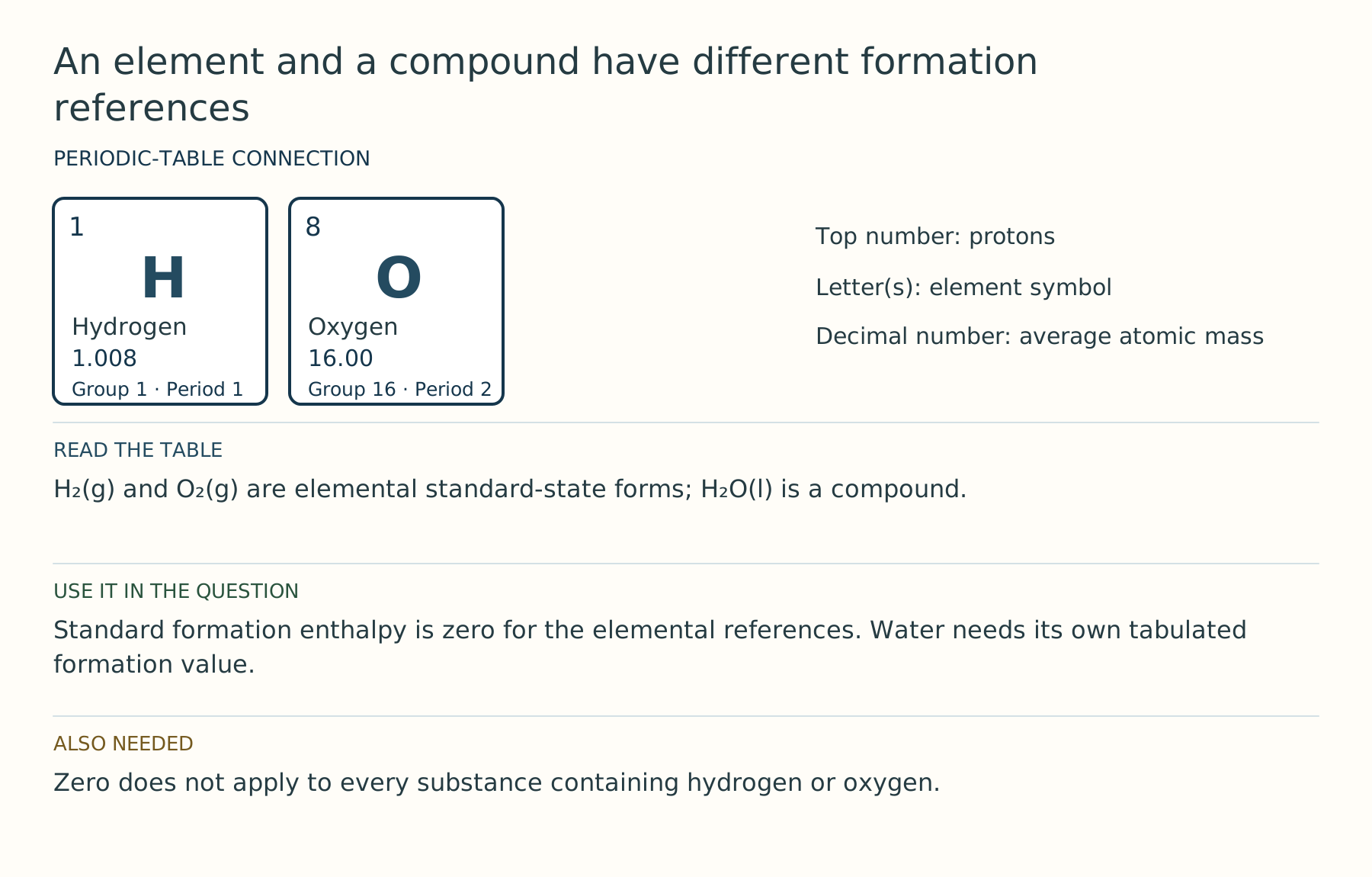
An element and a compound have different formation references. H₂(g) and O₂(g) are elemental standard-state forms; H₂O(l) is a compound. Standard formation enthalpy is zero for the elemental references. Water needs its own tabulated formation value. Zero does not apply to every substance containing hydrogen or oxygen.
Zero applies to the elements’ standard-state forms only, not to every substance containing H or O.
Bond energies as a climb and a drop (to scale)
H2 + Cl22H + 2Cl (separate atoms)2HClbreak: +679 kJenergy inform: −862 kJenergy outΔH ≈ −183 kJ
Break every reactant bond (up), then form every product bond (down). The net change is ΔH.

On the periodic table: The periodic table identifies the elements: H is atomic number 1 (1.008 u); O is atomic number 8 (16.00 u). These decimals are averages, not mass numbers; use supplied rounded masses when given.

On the periodic table: It also tells you which species are elements, such as H2(g) and O2(g), whose ΔH°f is 0. Formation values and bond energies themselves come from supplied data.

Worked example · 3 steps

Estimate ΔH for H2 + Cl2 → 2HCl. Bond energies: H–H 436, Cl–Cl 243, H–Cl 431 kJ/mol.

  1. 1
    Total the bonds broken

    Every reactant bond must break.

    Bond brokenCountEnergy (kJ/mol)Total (kJ)
    H–H1436436
    Cl–Cl1243243
    Sum679
  2. 2
    Total the bonds formed

    Two HCl molecules form two H–Cl bonds.

    2 × 431 kJ = 862 kJ
  3. 3
    Subtract

    Broken minus formed.

    ΔH ≈ 679 kJ − 862 kJ = −183 kJ
  4. ✓
    Answer

    ΔH ≈ −183 kJ: exothermic. More energy is released forming bonds than is spent breaking them.

Your turn

Enthalpy of reaction practice problems

Answer first, then check. Hints open one at a time; the answer and full solution open after you try.

Problem 1 of 4 · warm-up

What standard formation enthalpy is assigned to C(s, graphite), an element in its standard state?

Hint 1 · the clue

6C12.01On the periodic table: Carbon (C) has its own box, atomic number 6, so C(s, graphite) is a pure element, not a compound.

Standard formation enthalpy of an element is asked.

Hint 2 · the next move

An element in its standard state and its formation enthalpy are asked: recall the zero reference rule.

Your path:

  1. Recall the definition of ΔH°f
  2. Making an element from itself → no change
  3. Standard-state element → 0 kJ/mol
Answer

Answer: 0 kJ/mol

Full worked solution

What you know: C(s, graphite) is the element carbon in its standard state. What you want: its standard formation enthalpy.

  1. Recall the definition. Standard formation enthalpy is the enthalpy change for making one mole of a substance from its elements in their standard states.
  2. Graphite already is carbon in its standard state. Making it from itself means no change at all.
  3. So the standard-state form of an element is the zero reference: ΔH°f = 0 kJ/mol.

Why it matters: This is why elements like O2(g) and C(s, graphite) count as zero when you take products minus reactants.

Watch out: The zero applies only to the standard-state form. A compound such as CO2 has a nonzero value.

Your route: Recognize element in standard state → Zero reference

Answer: 0 kJ/mol

Problem 2 of 4

A bond-energy estimate needs 600 kJ to break bonds and releases 650 kJ when new bonds form. What is ΔH?

Hint 1 · the clue

Bond energy totals are supplied.

Hint 2 · the next move

Energy to break bonds and energy released forming bonds are given: use broken minus formed to estimate ΔH.

Your path:

  1. ΔH ≈ bonds broken − bonds formed
  2. Insert the two totals
  3. Negative → exothermic
Answer

Answer: −50 kJ

Full worked solution

What you know: Breaking bonds takes 600 kJ. Forming new bonds releases 650 kJ. What you want: the estimated ΔH.

  1. Use the bond-energy estimate: ΔH ≈ Σ(bonds broken) − Σ(bonds formed). Energy goes in to break bonds and comes out when bonds form.
  2. Insert the totals: ΔH ≈ 600 kJ − 650 kJ = −50 kJ.

Check: More energy is released forming bonds than is spent breaking them, so the reaction gives off energy overall. A negative ΔH fits.

Watch out: Do not reverse the order. Formed minus broken would give +50 kJ, the wrong sign.

Your route: Energy to break → Minus energy released forming

Answer: −50 kJ

YOUR PERIODIC-TABLE REFERENCE

1HHydrogen1.008Group 1 · Period 1

Atomic number identifies proton count. The decimal mass is an average, not an isotope’s mass number. Use supplied rounded masses when a problem gives them.

Problem 3 of 4

Bonds broken require 500 kJ; bonds formed release 650 kJ. Estimated ΔH?

Hint 1 · the clue

Use ΔH ≈ Σ(bonds broken) − Σ(bonds formed), in that order.

Hint 2 · the next move

Energy for bonds broken and bonds formed is given: estimate ΔH as broken minus formed.

Your path:

  1. ΔH ≈ bonds broken − bonds formed
  2. Insert the two totals
  3. Negative → exothermic
Answer

500 − 650 = −150 kJ.

Full worked solution

What you know: Bonds broken require 500 kJ. Bonds formed release 650 kJ. What you want: the estimated ΔH.

  1. Use ΔH ≈ Σ(bonds broken) − Σ(bonds formed). Breaking bonds takes energy in. Forming bonds releases energy.
  2. Insert the totals: 500 − 650 = −150 kJ.

Check: Forming bonds releases more energy than breaking them costs, so the reaction is exothermic. A negative value fits.

Watch out: Bond energies are approximate gas-phase values, so this is an estimate. Also keep the order: broken minus formed, not the reverse.

Answer: 500 − 650 = −150 kJ.

Problem 4 of 4

CH4(g) + 2O2(g) → CO2(g) + 2H2O(l). ΔH°f values: CH4 −75, CO2 −394, H2O(l) −286 kJ/mol. Find ΔH°rxn.

Hint 1 · the clue

O2 is an element in its standard state, so its value is 0. Multiply each value by its coefficient.

Hint 2 · the next move

Formation enthalpies (ΔH°f) for each substance are given and ΔH°rxn is asked: use products minus reactants.

Your path:

  1. O2(g) is an element → ΔH°f = 0
  2. Sum products × coefficients
  3. Sum reactants × coefficients
  4. ΔH°rxn = products − reactants
Answer

−891 kJ

Full worked solution

What you know: CH4(g) + 2O2(g) → CO2(g) + 2H2O(l). ΔH°f: CH4 −75, CO2 −394, H2O(l) −286 kJ/mol. What you want: ΔH°rxn.

  1. Note that O2(g) is an element in its standard state, so its ΔH°f = 0.
  2. Add the products, each times its coefficient: 1(−394) + 2(−286) = −394 − 572 = −966 kJ.
  3. Add the reactants the same way: 1(−75) + 2(0) = −75 kJ.
  4. Take products minus reactants: ΔH°rxn = −966 − (−75) = −966 + 75 = −891 kJ.

Check: Burning methane releases heat, so a large negative value makes sense.

Watch out: Two traps: forgetting to multiply −286 by 2, and dropping the double negative. Subtracting −75 means adding 75.

Answer: −891 kJ

Watch out

Common enthalpy of reaction mistakes