ChemGem

How to Tell Exothermic from Endothermic (Step-by-Step, with Practice)

Every heat sign depends on what you call the system (the part you are studying). Choose the system first, then ask whether heat leaves it or enters it.

Spot it, solve it, practice it: 4 steps, 1 worked example, 4 practice problems. Free, no account.

The route · 4 steps

  1. Name the system.
  2. Decide whether heat leaves it or enters it.
  3. Leaving: q is negative (exothermic). Entering: q is positive (endothermic).
  4. Give the surroundings the same size with the opposite sign.
Spot it

How to recognize heat sign questions

Look for heat being released, absorbed, leaving, or entering, and a question about the sign of q or ΔH for a chosen system.

Example wording, with the clue words marked:

A reaction releases 45 kJ to the surroundings at constant pressure with only pressure–volume work. What is its ΔH?

Not sure it’s this type? Compare the neighbors:

Step-by-step

Worked example: heat sign

The idea

System or surroundings?
System
The reaction or object you choose to study.
Surroundings
Everything else: the container, the water, the room.
Follow the heat arrow across the boundary
ExothermicEndothermicsurroundingssurroundingssystemsystemheat leaves the systemheat enters the systemq < 0q > 0
The dashed line is the system boundary. Heat flows from hotter to colder.
Direction of heat sets the sign
Heat flowNameSign of qEveryday case
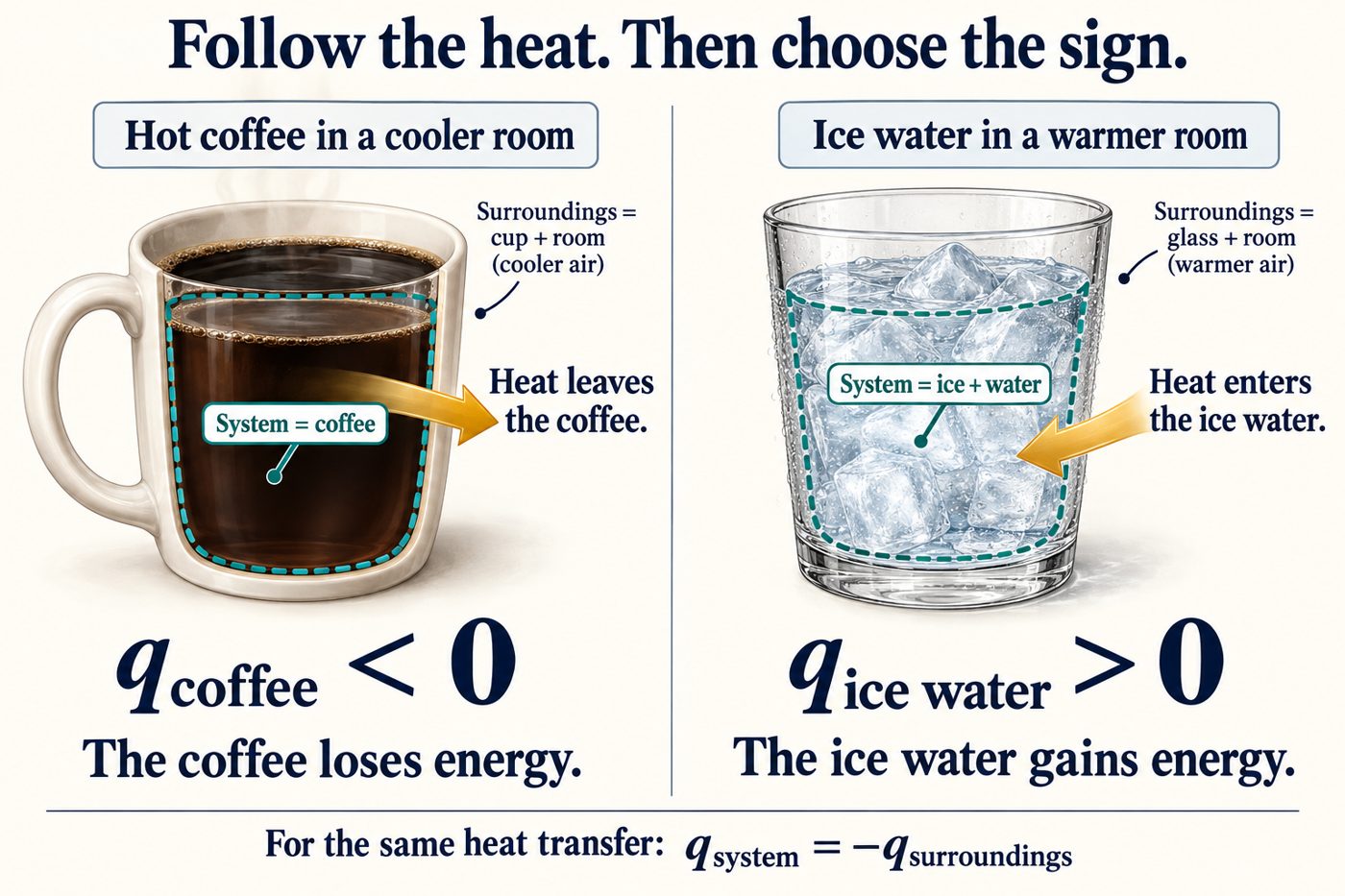
Out of the systemExothermicq < 0 (negative)Hot coffee cooling in a room
Into the systemEndothermicq > 0 (positive)Ice water warming in a room
Hot coffee is the system and loses heat to a cooler room: q coffee is negative. Ice plus water is the system in a warmer room and gains heat: q ice water is positive. For the same heat exchange, system and surroundings have opposite heat signs.
The cup or glass and the room are the surroundings.
One heat exchange, two opposite signs
qsystem = −qsurroundings
q = ΔH
The second line holds at constant pressure with only pressure–volume work. Enthalpy change, ΔH: the heat change measured that way.

On the periodic table: On the periodic table, H has atomic number 1 (its proton count) and average atomic mass 1.008 u. That decimal is an average, not an isotope’s mass number; use supplied rounded masses when a problem gives them.

On the periodic table: Heat signs need no periodic-table value: they come from the direction of heat flow.

Worked example · 3 steps

A reaction releases 40 kJ to its surroundings. Assign the heat signs.

  1. 1
    Choose the reaction as the system

    A sign describes heat entering or leaving the chosen system. Here heat moves out of the reaction.

    PartRoleHeat
    ReactionSystemLeaves (40 kJ out)
    Everything elseSurroundingsEnters (40 kJ in)
  2. 2
    Write the reaction’s heat

    Losing heat gives the reaction a negative q.

    qreaction = −40 kJ
  3. 3
    Write the surroundings’ heat

    The surroundings receive that same heat, so their q is positive.

    qsurroundings = −qreaction = −(−40 kJ) = +40 kJ
  4. ✓
    Answer

    qreaction = −40 kJ (exothermic); qsurroundings = +40 kJ

Your turn

Heat sign practice problems

Answer first, then check. Hints open one at a time; the answer and full solution open after you try.

Problem 1 of 4 · warm-up

A reaction releases 45 kJ to the surroundings at constant pressure with only pressure–volume work. What is its ΔH?

Hint 1 · the clue

The reaction releases heat.

Hint 2 · the next move

Heat is released to the surroundings at constant pressure: choose the reaction as system, so ΔH is negative.

Your path:

  1. Choose the reaction as the system
  2. Heat leaves → q is negative
  3. Constant pressure: ΔH = q
Answer

Answer: −45 kJ

Full worked solution

What you know: The reaction releases 45 kJ to the surroundings. Pressure is constant and only pressure–volume work happens. What you want: ΔH for the reaction.

  1. Choose the reaction as the system. The heat moves out of it, into the surroundings.
  2. Heat leaving the system means q is negative: qreaction = −45 kJ. The reaction is exothermic.
  3. At constant pressure with only pressure–volume work, q = ΔH. So ΔH = −45 kJ.

Check: The surroundings gain the same heat, so qsurroundings = +45 kJ. The two values are equal and opposite.

Watch out: Do not write +45 kJ just because the surroundings warm up. The sign belongs to the reaction, which lost energy.

Your route: Name reaction as system → Heat leaves → Negative

Answer: −45 kJ

YOUR PERIODIC-TABLE REFERENCE

1HHydrogen1.008Group 1 · Period 1

Atomic number identifies proton count. The decimal mass is an average, not an isotope’s mass number. Use supplied rounded masses when a problem gives them.

Problem 2 of 4

A reaction releases 50 kJ to the surroundings at constant pressure with only pressure–volume work. What is its ΔH?

Hint 1 · the clue

The reaction releases heat.

Hint 2 · the next move

Heat is released to the surroundings at constant pressure: choose the reaction as system, so ΔH is negative.

Your path:

  1. Choose the reaction as the system
  2. Heat leaves → q is negative
  3. Constant pressure: ΔH = q
Answer

Answer: −50 kJ

Full worked solution

What you know: The reaction releases 50 kJ to the surroundings. Pressure is constant and only pressure–volume work happens. What you want: ΔH for the reaction.

  1. Choose the reaction as the system. The heat moves out of it, into the surroundings.
  2. Heat leaving the system means q is negative: qreaction = −50 kJ. The reaction is exothermic.
  3. At constant pressure with only pressure–volume work, q = ΔH. So ΔH = −50 kJ.

Check: The surroundings gain the same heat, so qsurroundings = +50 kJ. The two values are equal and opposite.

Watch out: Do not write +50 kJ just because the surroundings warm up. The sign belongs to the reaction, which lost energy.

Your route: Name reaction as system → Heat leaves → Negative

Answer: −50 kJ

YOUR PERIODIC-TABLE REFERENCE

1HHydrogen1.008Group 1 · Period 1

Atomic number identifies proton count. The decimal mass is an average, not an isotope’s mass number. Use supplied rounded masses when a problem gives them.

Problem 3 of 4

In an insulated reaction-water pair, water absorbs +220 J. Ignore the calorimeter. What is q for the reaction?

Hint 1 · the clue

The surrounding water warms in an insulated setup.

Hint 2 · the next move

An insulated setup where water absorbs heat: heat lost by the reaction equals heat gained by the water, opposite sign.

Your path:

  1. Reaction is system; water is surroundings
  2. Insulated: qreaction = −qwater
  3. Flip the sign of water's heat
Answer

Answer: −220 J

Full worked solution

What you know: The setup is insulated, so no heat escapes. The water absorbs +220 J, and the calorimeter is ignored. What you want: q for the reaction.

  1. Separate the two parts. The reaction is the system. The water is the surroundings.
  2. In an insulated setup, heat lost equals heat gained. So qreaction = −qwater.
  3. Insert the value: qreaction = −(+220 J) = −220 J. The reaction released the heat that warmed the water.

Check: Add the two heats: −220 J + 220 J = 0. Nothing is lost in an insulated setup, so the total must be zero.

Watch out: The water's heat is not the reaction's heat. They have the same size but opposite signs.

Your route: Separate system and surroundings → Opposite heat signs

Answer: −220 J

Problem 4 of 4

Heat leaves the system. Sign of q?

Hint 1 · the clue

Identify the requested heat quantity and the appropriate relation. Keep units consistent and check whether energy enters or leaves the stated system.

Hint 2 · the next move

Heat leaving the system with a sign asked: the system loses energy, so q is negative.

Your path:

  1. Take the system's point of view
  2. Heat leaving → energy lost
  3. Energy lost → q negative
Answer

Negative; the system loses energy.

Full worked solution

What you know: Heat leaves the system. What you want: the sign of q.

  1. Remember that q is defined from the system's point of view.
  2. Heat leaving the system means the system loses energy. That is an exothermic change.
  3. Losing energy gives a negative q. So q is negative; the system loses energy.

Why it matters: The surroundings gain that same heat, so their q is positive. For the same exchange, qsystem = −qsurroundings.

Watch out: Warmer surroundings do not mean a positive q for the system. Always ask which side you chose as the system.

Answer: Negative; the system loses energy.

Watch out

Common heat sign mistakes