ChemGem

How to Calculate Heat with Specific Heat (Step-by-Step, with Practice)

Warming or cooling a sample takes heat. How much depends on its mass, its specific heat and its temperature change, tied together by q = mcΔT.

Spot it, solve it, practice it: 3 steps, 1 worked example, 3 practice problems. Free, no account.

The route · 3 steps

  1. Find ΔT: final minus initial temperature.
  2. Multiply m × c × ΔT, or rearrange for the unknown.
  3. Check the sign and units; convert J to kJ if asked.
Spot it

How to recognize specific heat questions

Look for mass, specific heat c in J/(g·°C), and starting and ending temperatures, with heat q asked for.

Example wording, with the clue words marked:

150 g of a material with c = 2.0 J/(g·°C) warms from 20°C to 24°C. What heat does it absorb?

Not sure it’s this type? Compare the neighbors:

Step-by-step

Worked example: specific heat

The idea

Heat = mass × specific heat × temperature change
q = m × c × ΔT
ΔT = Tfinal − Tinitial
q in J, m in g, c in J/(g·°C), ΔT in °C. One phase only.
The same equation, rearranged
ΔT = qm × c
C = m × c    and    q = C × ΔT
Specific heat, c: heat to warm 1 g by 1 °C. Heat capacity, C: the same for the whole sample.
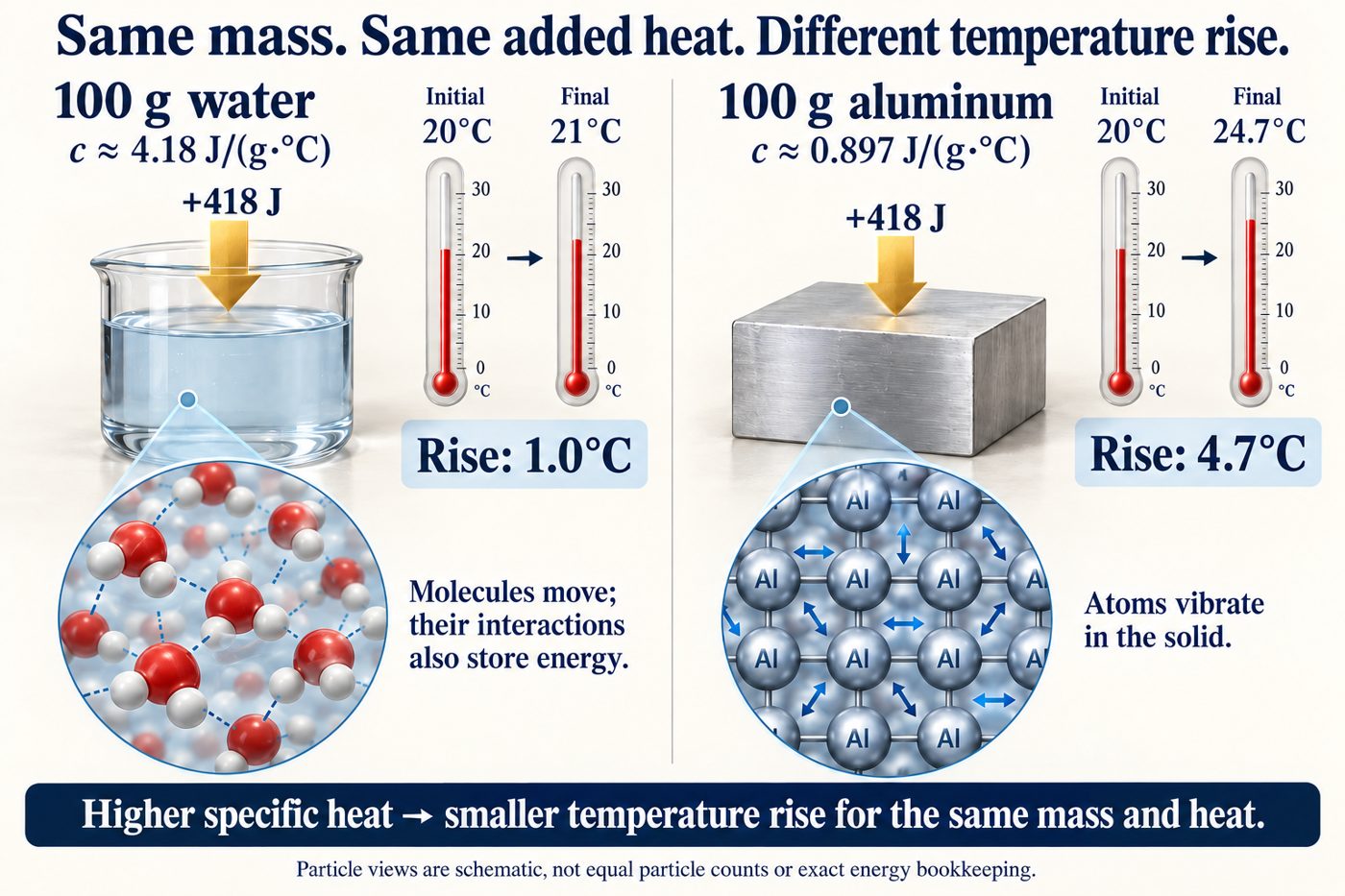
Equal 100 g samples of water and aluminum start at 20 degrees Celsius and each receive 418 J. Water rises about 1 degree; aluminum about 4.7 degrees. Water molecules move and interact; aluminum atoms vibrate in a solid lattice. Particle pictures are schematic.
Same mass, same heat: water warms less. Particle pictures are schematic.
Approximate specific heats near room temperature
Substancec (J/(g·°C))Heat to warm 100 g by 1 °C
Water (liquid)4.184418 J
Aluminum0.89789.7 J
Iron0.44944.9 J
Copper0.38538.5 J
Water’s large c helps it moderate temperature changes. Source: OpenStax.
Same heat, different warming (100 g samples from 20 °C)
202122232425260100200300400418 JAluminumWater24.7 °C21.0 °CHeat added (J)Temperature (°C)
Lower specific heat, steeper line.
Two quantities with nearly the same name
Specific heat, c
Per gram, J/(g·°C). Same for any amount.
Heat capacity, C
Per sample, J/°C. 100 g water: 418; 200 g: 837.
Signs, units and calorimeters
  • Warming gives positive q; cooling gives negative q.
  • A temperature difference has the same value in kelvin and °C.
  • Insulated calorimeter: heat lost = heat gained. Include the calorimeter’s heat capacity if given.
  • Added energy speeds particles and changes their interactions. Temperature is not total energy.
  • Heating speed also depends on heat transfer, size and surroundings.

On the periodic table: The periodic table gives molar masses, not specific heats: H 1.008 and O 16.00 make H2O about 18.02 g/mol.

On the periodic table: q = mcΔT uses the sample’s mass in grams. Specific heat is supplied or read from a data table.

Worked example · 4 steps

Equal 100 g samples of water and aluminum each absorb 418 J. Which warms more? Use c = 4.18 J/(g·°C) for water and 0.90 J/(g·°C) for aluminum.

  1. 1
    Rearrange for ΔT

    ΔT is the unknown.

    ΔT = qm × c
  2. 2
    Water

    Grams and joules cancel, leaving °C.

    ΔT = 418 J100 g × 4.18 J/(g·°C) = 1.0 °C
  3. 3
    Aluminum

    Rounded c gives 4.6 °C; c = 0.897 gives 4.7 °C.

    ΔT = 418 J100 g × 0.90 J/(g·°C) ≈ 4.6 °C
    ΔT = 418 J100 g × 0.897 J/(g·°C) ≈ 4.7 °C
  4. 4
    Compare

    Lower specific heat, bigger rise.

    Sample (100 g)c (J/(g·°C))ΔT for 418 J
    Water4.181.0 °C
    Aluminum0.90 (0.897)4.6 °C (4.7 °C)
  5. ✓
    Answer

    Aluminum warms more (about 4.6 °C, or 4.7 °C with c = 0.897, vs 1.0 °C) because its specific heat is lower.

Your turn

Specific heat practice problems

Answer first, then check. Hints open one at a time; the answer and full solution open after you try.

Problem 1 of 3 · warm-up

150 g of a material with c = 2.0 J/(g·°C) warms from 20°C to 24°C. What heat does it absorb?

Hint 1 · the clue

Mass, specific heat, and two temperatures are given.

Hint 2 · the next move

Mass, specific heat, and a temperature change are given, and heat is asked: that signals q = mcΔT.

Your path:

  1. ΔT = final − initial
  2. Use q = mcΔT
  3. Units cancel to joules
Answer

Answer: 1200 J

Full worked solution

What you know: m = 150 g, c = 2.0 J/(g·°C), and the material warms from 20°C to 24°C. What you want: the heat q it absorbs.

  1. Find the temperature change as final minus initial: ΔT = 24°C − 20°C = 4°C. It is positive because the material warms.
  2. Use q = mcΔT, which fits because there is no phase change.
  3. Insert the values: q = 150 g × 2.0 J/(g·°C) × 4°C. Grams cancel and °C cancels, leaving joules. 150 × 2.0 = 300, and 300 × 4 = 1200. So q = 1200 J.

Check: Work backward: 1200 J ÷ (150 g × 2.0 J/(g·°C)) = 4°C, the temperature change you started with. The positive sign fits, since a warming material absorbs heat.

Watch out: Use the change in temperature (4°C), not the final temperature (24°C). Using 24 would give an answer six times too large.

Your route: Final minus initial → q = mcΔT

Answer: 1200 J

YOUR PERIODIC-TABLE REFERENCE

6CCarbon12.01Group 14 · Period 2

Atomic number identifies proton count. The decimal mass is an average, not an isotope’s mass number. Use supplied rounded masses when a problem gives them.

Problem 2 of 3

175 g of a material with c = 2.0 J/(g·°C) warms from 20°C to 24°C. What heat does it absorb?

Hint 1 · the clue

Mass, specific heat, and two temperatures are given.

Hint 2 · the next move

Mass, specific heat, and a temperature change are given, and heat is asked: that signals q = mcΔT.

Your path:

  1. ΔT = final − initial
  2. Use q = mcΔT
  3. Units cancel to joules
Answer

Answer: 1400 J

Full worked solution

What you know: m = 175 g, c = 2.0 J/(g·°C), and the material warms from 20°C to 24°C. What you want: the heat q it absorbs.

  1. Find the temperature change as final minus initial: ΔT = 24°C − 20°C = 4°C. It is positive because the material warms.
  2. Use q = mcΔT, which fits because there is no phase change.
  3. Insert the values: q = 175 g × 2.0 J/(g·°C) × 4°C. Grams cancel and °C cancels, leaving joules. 175 × 2.0 = 350, and 350 × 4 = 1400. So q = 1400 J.

Check: Work backward: 1400 J ÷ (175 g × 2.0 J/(g·°C)) = 4°C, the temperature change you started with. The positive sign fits, since a warming material absorbs heat.

Watch out: Use the change in temperature (4°C), not the final temperature (24°C). Using 24 would give an answer six times too large.

Your route: Final minus initial → q = mcΔT

Answer: 1400 J

YOUR PERIODIC-TABLE REFERENCE

6CCarbon12.01Group 14 · Period 2

Atomic number identifies proton count. The decimal mass is an average, not an isotope’s mass number. Use supplied rounded masses when a problem gives them.

Problem 3 of 3

m = 10 g, c = 2.0 J/(g·°C), temperatures 20°C → 25°C. q?

Hint 1 · the clue

Find ΔT = final − initial first, then use q = mcΔT. The g and °C units cancel, leaving J.

Hint 2 · the next move

Mass, specific heat, and two temperatures are given with q asked: that signals q = mcΔT.

Your path:

  1. ΔT = final − initial
  2. Use q = mcΔT
  3. Units cancel to joules
Answer

ΔT = 5°C; q = 10 × 2.0 × 5 = +100 J.

Full worked solution

What you know: m = 10 g, c = 2.0 J/(g·°C), temperature goes from 20°C to 25°C. What you want: q.

  1. Find ΔT as final minus initial: 25°C − 20°C = 5°C.
  2. Use q = mcΔT, since the material warms with no phase change.
  3. Insert the values: q = 10 g × 2.0 J/(g·°C) × 5°C. Grams and °C cancel, leaving joules. 10 × 2.0 = 20, and 20 × 5 = 100. So ΔT = 5°C; q = 10 × 2.0 × 5 = +100 J.

Check: 100 J ÷ (10 g × 2.0 J/(g·°C)) = 5°C, which matches. q is positive because the material warms and absorbs heat.

Watch out: Use ΔT, not the final temperature of 25°C.

Answer: ΔT = 5°C; q = 10 × 2.0 × 5 = +100 J.

YOUR PERIODIC-TABLE REFERENCE

6CCarbon12.01Group 14 · Period 2

Atomic number identifies proton count. The decimal mass is an average, not an isotope’s mass number. Use supplied rounded masses when a problem gives them.

Watch out

Common specific heat mistakes