
Chapter 0 · Free lesson
Math first: units, measurement, and matter
The full lesson, free. For instant answer checking, hints and progress tracking, open the interactive version.
What you will study
- Conversion factors and unit cancellation
- Metric prefixes: nano to mega
- Solving for an unknown
- Measurement: density, precision, and significant figures
- Matter: elements, compounds, mixtures, and states
- Changes, heat, and scientific methods
By the end, you can…
- Set up a conversion, cancel units, and calculate the wanted unit.
- Read a metric prefix as a power of ten, and use it to convert between prefixed units and base units.
- Isolate an unknown by applying the same operation to both sides.
- Use density to connect mass and volume; distinguish accuracy from precision and round by the calculation rule.
- Calculate with numbers in scientific notation.
- Classify matter as an element, a compound, or a mixture, and describe solids, liquids, and gases at the particle level.
- Tell physical from chemical changes and properties, explain heat in terms of particle motion, and describe how scientists test ideas.
These are the skills to check, not just pages to finish. Use the section goals while studying, then try the chapter checks without hints.
0.1 Dimensional analysis: let the units show the route
Dimensional analysis changes units with conversion fractions. Matching units cancel. The unit left over shows whether you reached the answer asked for: 18 grams is not 18 moles.
- Write the given amount over 1. That 1 has no unit and changes nothing.
- Old unit underneath, wanted unit on top.
- Multiply the tops, multiply the bottoms, then divide.
Same amount, new unit.
A recipe from balanced coefficients. It links moles of different substances.
- Keep the substance name with each unit. mol H2 cancels only mol H2, not mol H2O.
- Cancel factors in multiplication, not terms across + or −.
- Celsius to kelvin adds 273.15; it is not a ratio.
| Unit | Factor | Value |
|---|---|---|
| Length (cm) | 100 cm1 m | 100 cm/m |
| Area (cm2) | (100 cm1 m)2 | 104 cm2/m2 |
| Volume (cm3) | (100 cm1 m)3 | 106 cm3/m3 |
| Conversion | Key factor |
|---|---|
| g → mol → atoms, molecules or formula units | Molar mass, then Avogadro’s number |
| g reactant → mol → mol product → g product | Coefficient ratio between two molar masses |
| mL → L before molarity | Molarity is mol/L |
| Gas mass → mol before PV = nRT | n is moles, not grams |
| J ⇄ kJ | 1 kJ1000 J or its flip |
| g → mol → phase-change heat | Enthalpy is kJ/mol: reach moles first |
- Write the given amount with its unit, over 1.
- Name the wanted unit.
- Add factors with each unwanted unit underneath.
- Cancel matching units; multiply tops, multiply bottoms, divide.
- Check the final unit and the size of the answer.
On the periodic table: Molar masses come from the decimal number in each box: hydrogen (H) 1.008, oxygen (O) 16.00 g/mol.
A water bottle holds 250 mL. How many liters is that?
| Given | 250 mL |
|---|---|
| Find | L |
| Factor | 1000 mL = 1 L |
- 1Line up the factor
mL goes underneath so it cancels.
250 mL1 × 1 L1000 mL - 2Cancel, multiply, divide
Only L remains.
250mL1 × 1 L1000mL= 2501000 L = 0.250 L - ✓Answer
0.250 L. Liters are bigger, so fewer of them.
A warehouse receives 250000 mg of vitamin powder, but the shipping form asks for kilograms. What number goes on the form?
| Given | 250000 mg |
|---|---|
| Find | kg |
| Factors | 1000 mg = 1 g; 1000 g = 1 kg |
- 1Line up two factors
mg underneath first, then g.
250000 mg1 × 1 g1000 mg × 1 kg1000 g - 2Cancel, multiply, divide
mg cancels, then g. Only kg is left.
250000mg1 × 1g1000mg× 1 kg1000g= 2500001000000 kg = 0.250 kg - 3Same route, one factor at a time
Each line changes one unit.
Do this Result 250000 mg × 1 g1000 mg 250 g 250 g × 1 kg1000 g 0.250 kg - ✓Answer
0.250 kg
A recipe says to boil an egg for 3 min, but your phone timer counts only seconds. How many seconds should you set?
| Given | 3 min |
|---|---|
| Find | s |
| Factor | 1 min = 60 s |
- 1Line up the factor
min underneath; seconds on top.
3 min1 × 60 s1 min - 2Cancel, multiply, divide
Dividing by 1 leaves the number unchanged.
3min1 × 60 s1min= 1801 s = 180 s - ✓Answer
180 s: three groups of 60 s.
A highway sign in the United States says 60 miles/h. A visitor from Canada is driving her own car, and its speedometer reads in km/h. What speed should she read?
| Given | 60 miles/h |
|---|---|
| Find | km/h |
| Factor | 1 mile = 1.609344 km |
| Round | one decimal place |
- 1Line up the factor
Cancel miles. Keep h: still per hour.
60 miles1 h × 1.609344 km1 mile - 2Cancel, multiply, divide
Mile and miles are one unit. km/h remains.
60miles1 h × 1.609344 km1mile= 96.56064 km1 h - 3Round only at the end
One decimal place.
96.56064 km/h → 96.6 km/h - ✓Answer
96.6 km/h
A mouthful of water has a mass of 18.0 g. How many water molecules does it contain?
| Given | 18.0 g H2O |
|---|---|
| Find | H2O molecules |
| Factors | 1 mol H2O = 18.0 g H2O (supplied molar mass) 1 mol H2O = 6.022 × 10²³ H2O molecules |
- 1Line up two factors
Grams underneath first, then moles.
18.0 g H2O1 × 1 mol H2O18.0 g H2O × 6.022 × 1023 molecules1 mol H2O - 2Cancel, multiply, divide
Grams cancel, then moles.
18.0g H2O1 × 1mol H2O18.0g H2O× 6.022 × 1023 molecules1mol H2O= 1.08396 × 102518.0 molecules = 6.022 × 10²³ → 6.02 × 10²³ - 3Same route, one factor at a time
Molar mass, then the counting factor.
Do this Result 18.0 g H2O × 1 mol H2O18.0 g H2O 1.00 mol H2O 1.00 mol H2O × 6.022 × 1023 molecules1 mol H2O 6.02 × 10²³ molecules - ✓Answer
6.02 × 10²³ H2O molecules (three significant figures; rounding rules are in 0.3)
A small fuel cell combines 4.0 g of hydrogen gas (H2) with oxygen. How many grams of water can it make?
| Given | 4.0 g H2; enough O2 to react with all of it |
|---|---|
| Find | g H2O |
| Equation | 2H2 + O2 → 2H2O |
| Factors | 1 mol H2 = 2.0 g H2; 1 mol H2O = 18 g H2O (supplied approximate masses) Reaction factor: 2 mol H2O / 2 mol H2 |
- 1Line up three factors
The balanced equation supplies the middle factor.
4.0 g H21 × 1 mol H22.0 g H2 × 2 mol H2O2 mol H2 × 18 g H2O1 mol H2O - 2Cancel, multiply, divide
Tops: 4.0 × 1 × 2 × 18 = 144. Bottoms: 1 × 2.0 × 2 × 1 = 4.0.
4.0g H21 × 1mol H22.0g H2× 2mol H2O2mol H2× 18 g H2O1mol H2O= 1444.0 g H2O = 36 g H2O - 3Same route, one factor at a time
Reactant moles, then product moles, then product grams.
Do this Result 4.0 g H2 × 1 mol H22.0 g H2 2.0 mol H2 2.0 mol H2 × 2 mol H2O2 mol H2 2.0 mol H2O 2.0 mol H2O × 18 g H2O1 mol H2O 36 g H2O - ✓Answer
36 g H2O. Oxygen adds mass, so product outweighs the hydrogen.
A lab bench top has an area of 1.50 m2. What is its area in cm2?
- 1Find the link
Area needs this length factor squared.
1 m = 100 cm - 2Square the factor
Square the numbers and the units: 100 × 100 = 10,000.
(100 cm1 m)2 = 10,000 cm21 m2 - 3Put m2 underneath and calculate
Scientific notation shows 1.50’s three significant figures.
1.50m2× 10,000 cm21m2= 15,000 cm2 = 1.50 × 104 cm2 - ✓Answer
1.50 × 104 cm2
Dimensional analysis: twelve questions for you
Write one continuous factor setup. Multiply the numerators, multiply the denominators, then divide. These everyday conversions help you learn the method before chemistry calculations.
Section practice · 12 questions · tap to open
What this set is for: practicing the method from this section while it’s fresh. Every problem uses only what this section has taught.
Practice 1
A soup recipe calls for 600 mL of broth, but your measuring cup is marked in liters. How many liters do you need? (1000 mL = 1 L)
Give me a hint
Put mL in the denominator of your conversion factor.
Check the answer
Answer: 0.600 L
Explain the worked problem to me
What you know: The recipe needs 600 mL of broth, and 1000 mL = 1 L. What you want: liters of broth.
- Write the input and put mL underneath in the factor so it cancels: 600 mL × (1 L / 1000 mL).
- mL cancels, leaving L. Divide: 600 ÷ 1000 = 0.600. The answer is 0.600 L.
Check: A liter is bigger than a milliliter, so you need fewer of them. 0.600 is smaller than 600, which makes sense.
Watch out: Multiplying by 1000 instead (600000 L) means the factor was upside down and mL would not cancel.
That’s right: 0.600 L
Practice 2
You pour a 1.50 L bottle of sparkling water into a pitcher marked in milliliters. How many milliliters is that? (1000 mL = 1 L)
Give me a hint
A smaller unit needs a larger numerical count.
Check the answer
Answer: 1500 mL
Explain the worked problem to me
What you know: The bottle holds 1.50 L, and 1000 mL = 1 L. What you want: milliliters.
- Now L is the unit to remove, so L goes underneath: 1.50 L × (1000 mL / 1 L).
- L cancels, leaving mL. Multiply: 1.50 × 1000 = 1500. The answer is 1500 mL.
Check: A milliliter is much smaller than a liter, so the count must get bigger. 1500 is bigger than 1.50.
Watch out: This is the flipped version of the mL → L factor. Always put the unit you are getting rid of on the bottom.
That’s right: 1500 mL
Practice 3
A small bag of trail mix contains 4500 mg of protein. How many grams of protein is that? (1000 mg = 1 g)
Give me a hint
Choose the factor with mg underneath.
Check the answer
Answer: 4.5 g
Explain the worked problem to me
What you know: The trail mix has 4500 mg of protein, and 1000 mg = 1 g. What you want: grams of protein.
- Put mg underneath so it cancels: 4500 mg × (1 g / 1000 mg).
- mg cancels, leaving g. Divide: 4500 ÷ 1000 = 4.5. The answer is 4.5 g.
Check: A gram is bigger than a milligram, so the number shrinks. 4.5 × 1000 = 4500 takes you back to the start.
Watch out: The "milli" prefix means one thousandth. Going from mg to g, divide by 1000; do not multiply.
That’s right: 4.5 g
Practice 4
A lab’s inventory software records a bag of coffee beans as 250000 mg. What is its mass in kilograms? (1000 mg = 1 g, 1000 g = 1 kg)
Give me a hint
Use two bridges: mg → g → kg.
Check the answer
Answer: 0.250 kg
Explain the worked problem to me
What you know: The bag of beans is 250000 mg, 1000 mg = 1 g, and 1000 g = 1 kg. What you want: kilograms.
- No single factor goes from mg to kg, so use two bridges: mg → g → kg.
- Set up both factors with the old unit underneath: 250000 mg × (1 g / 1000 mg) × (1 kg / 1000 g).
- mg cancels, then g cancels, leaving kg. Multiply the bottoms: 1000 × 1000 = 1000000. Divide: 250000 ÷ 1000000 = 0.250. The answer is 0.250 kg.
Check: A kilogram is a million milligrams, so the number should shrink a lot. 0.250 × 1000000 = 250000.
Watch out: Stopping after the first factor gives 250 g, which is the wrong unit.
That’s right: 0.250 kg
Practice 5
A chocolate bar has a mass of 0.080 kg. Your lab sheet records masses in milligrams. What is the bar’s mass in milligrams? (1000 g = 1 kg, 1000 mg = 1 g)
Give me a hint
Reverse both factors to leave mg.
Check the answer
Answer: 80000 mg
Explain the worked problem to me
What you know: The chocolate bar is 0.080 kg, 1000 g = 1 kg, and 1000 mg = 1 g. What you want: milligrams.
- Bridge through grams: kg → g → mg. Each factor has the old unit underneath.
- 0.080 kg × (1000 g / 1 kg) × (1000 mg / 1 g). kg cancels, then g cancels, leaving mg.
- Multiply: 0.080 × 1000 × 1000 = 80000. The answer is 80000 mg.
Check: Milligrams are a million times smaller than kilograms, so the number grows a lot. 80000 ÷ 1000000 = 0.080.
Watch out: 0.080 has two significant figures, so 8.0 × 10⁴ mg shows the precision more clearly than 80000.
That’s right: 80000 mg
Practice 6
A movie runs 90 min. How long is it in hours? (60 min = 1 h)
Give me a hint
The minute label must cancel.
Check the answer
Answer: 1.5 h
Explain the worked problem to me
What you know: The movie runs 90 min, and 60 min = 1 h. What you want: hours.
- Put min underneath so it cancels: 90 min × (1 h / 60 min).
- min cancels, leaving h. Divide: 90 ÷ 60 = 1.5. The answer is 1.5 h.
Check: An hour is longer than a minute, so the number shrinks. 1.5 h × 60 min/h = 90 min.
Watch out: 1.5 h means one and a half hours, not 1 hour 50 minutes. Time is not base 10.
That’s right: 1.5 h
Practice 7
An experiment must stir for 2.0 hours, and the stir plate’s timer is set in seconds. How many seconds should you enter? (60 min = 1 h, 60 s = 1 min)
Give me a hint
Start with hours; bridge through minutes.
Check the answer
Answer: 7200 s
Explain the worked problem to me
What you know: The experiment stirs for 2.0 h, 60 min = 1 h, and 60 s = 1 min. What you want: seconds.
- No factor goes straight from h to s, so bridge through minutes: h → min → s.
- 2.0 h × (60 min / 1 h) × (60 s / 1 min). h cancels, then min cancels, leaving s.
- Multiply: 2.0 × 60 × 60 = 7200. The answer is 7200 s.
Check: One hour is 3600 s, so two hours should be twice that: 2 × 3600 = 7200.
Watch out: Using only one factor of 60 gives 120, which is minutes, not seconds.
That’s right: 7200 s
Practice 8
Your friend finished a 5.0-mile run, and her race app shows distances in kilometers. How many kilometers did she run? (1 mile ≈ 1.609 km)
Give me a hint
Keep km above and miles below.
Check the answer
Answer: 8.0 km
Explain the worked problem to me
What you know: Your friend ran 5.0 miles, and 1 mile ≈ 1.609 km. What you want: kilometers.
- Put miles underneath so it cancels: 5.0 miles × (1.609 km / 1 mile).
- miles cancels, leaving km. Multiply: 5.0 × 1.609 = 8.045.
- Round: this is multiplication, and 5.0 has two significant figures, the fewest among the measured inputs. So 8.045 becomes 8.0 km.
Check: A kilometer is shorter than a mile, so you need more of them. 8.0 is bigger than 5.0.
That’s right: 8.0 km
Practice 9
Your car’s cruise control is set at 50 miles/h. A friend’s phone app shows speed in km/h. About what speed does the app show? (1 mile ≈ 1.609 km)
Give me a hint
Do not change hours when the requested unit still uses hours.
Check the answer
Answer: About 80 km/h
Explain the worked problem to me
What you know: The cruise control is set at 50 miles/h, and 1 mile ≈ 1.609 km. What you want: km/h.
- Only the distance unit changes. Hours is already in the wanted unit, so leave it alone.
- Put miles underneath: 50 miles/h × (1.609 km / 1 mile). miles cancels, leaving km/h.
- Multiply: 50 × 1.609 = 80.45. The answer is about 80 km/h.
Check: km numbers are about 1.6 times mile numbers. 50 × 1.6 = 80.
Watch out: Do not convert hours to minutes or seconds. The wanted unit still has h on the bottom.
That’s right: About 80 km/h
Practice 10
A car is moving at 72 km/h. What is that speed in meters per second (m/s)? (1000 m = 1 km, 3600 s = 1 h)
Give me a hint
Hours starts underneath, so place hours above in its conversion factor.
Check the answer
Answer: 20 m/s
Explain the worked problem to me
What you know: The car moves at 72 km/h, 1000 m = 1 km, and 3600 s = 1 h. What you want: m/s.
- Two units must change. km is on top, so its factor puts km underneath: (1000 m / 1 km).
- h is on the bottom, so its factor puts h on top: (1 h / 3600 s).
- 72 km/h × (1000 m / 1 km) × (1 h / 3600 s). km and h cancel, leaving m/s. Calculate: 72 × 1000 = 72000, then 72000 ÷ 3600 = 20. The answer is 20 m/s.
Check: Reverse it: 20 m/s × 3600 s/h = 72000 m/h = 72 km/h.
Watch out: Writing (3600 s / 1 h) leaves h2 on the bottom. A unit on the bottom needs its factor flipped.
That’s right: 20 m/s
Practice 11
A floor tile has an area of 225 cm2. What is its area in m2? (1 m = 100 cm)
Give me a hint
cm2 is cm × cm, so the factor (1 m / 100 cm) has to be squared. Put cm2 underneath.
Check the answer
Answer: 0.0225 m2
Explain the worked problem to me
What you know: The tile’s area is 225 cm2, and 1 m = 100 cm. What you want: area in m2.
- Square the length factor: (1 m / 100 cm)2 = 1 m2 / 10,000 cm2.
- Put cm2 underneath so it cancels: 225 cm2 × (1 m2 / 10,000 cm2).
- cm2 cancels, leaving m2. Divide: 225 ÷ 10,000 = 0.0225. The answer is 0.0225 m2.
Check: A square meter is much bigger than a square centimeter, so the number should get much smaller. Reverse it: 0.0225 m2 × 10,000 cm2/m2 = 225 cm2.
Watch out: Dividing by 100 only once gives 2.25 m2, which is 100 times too big. A tile is not over 2 m2.
That’s right: 0.0225 m2
Practice 12
A soda can holds 0.355 L. What is its volume in mL and in cm3? (1 L = 1000 mL, 1 mL = 1 cm3)
Give me a hint
Change L to mL first, with L underneath. Then use 1 mL = 1 cm3.
Check the answer
Answer: 355 mL = 355 cm3
Explain the worked problem to me
What you know: The can holds 0.355 L, 1 L = 1000 mL, and 1 mL = 1 cm3. What you want: the volume in mL and in cm3.
- Put L underneath so it cancels: 0.355 L × (1000 mL / 1 L).
- L cancels, leaving mL. Multiply: 0.355 × 1000 = 355 mL.
- 1 mL = 1 cm3, so the number does not change: 355 mL × (1 cm3 / 1 mL) = 355 cm3. The answer is 355 mL = 355 cm3.
Check: A milliliter is smaller than a liter, so the number should get bigger. 355 cm3 ÷ 1000 cm3/L = 0.355 L.
Watch out: The 1000 in 1 L = 1000 cm3 comes from cubing 10 cm (10 × 10 × 10). Do not cube it again; mL and cm3 are the same size.
That’s right: 355 mL = 355 cm3
0.1a Metric prefixes: nano to mega
A metric prefix is a multiplier on the front of a base unit. Kilo means 1000, so 1 km = 1000 m. Each prefix means the same thing on meters, grams, liters and seconds, so you learn it once.
- Conversion factors with the old unit underneath (0.1).
- Multiplying and dividing by 10, 100, and 1000.
Need a refresher? Open the table of contents and revisit that topic before starting.
| Prefix | Symbol | Power of ten | Plain number | 1 ___ = ? base unit |
|---|---|---|---|---|
| mega | M | 106 | 1,000,000 | 1 MW = 1,000,000 W |
| kilo | k | 103 | 1000 | 1 km = 1000 m |
| (base unit) | none | 100 | 1 | 1 m = 1 m |
| deci | d | 10−1 | 0.1 | 1 dL = 0.1 L |
| centi | c | 10−2 | 0.01 | 1 cm = 0.01 m |
| milli | m | 10−3 | 0.001 | 1 mL = 0.001 L |
| micro | μ | 10−6 | 0.000001 | 1 μg = 0.000001 g |
| nano | n | 10−9 | 0.000000001 | 1 nm = 0.000000001 m |
| Prefix | Everyday size |
|---|---|
| Mega (M) | A large power plant: about 1000 MW. A phone photo: often 2 to 5 MB (megabytes), about 2 to 5 million bytes. |
| Kilo (k) | 1 km: about a 10 to 12 minute walk. 1 kg: about the mass of 1 L of water. |
| Base units | 1 L: a large water bottle. 1 g: about a paper clip or a US dollar bill. |
| Deci (d) | 1 dL = 100 mL, a little less than half a cup. Blood sugar tests report mg/dL. |
| Centi (c) | 1 cm: about the width of your smallest fingernail. |
| Milli (m) | 1 mL: about 20 drops; a teaspoon is about 5 mL. 1 mg: about 15 to 20 grains of table salt (one grain ≈ 0.06 mg). |
| Micro (μ) | A red blood cell: about 7 to 8 μm across. A human hair: roughly 50 to 100 μm thick. |
| Nano (n) | Visible light: about 400 nm (violet) to 700 nm (red). DNA strand: about 2 nm wide. Fingernails grow about 1 nm each second. |
No negative exponent.
Either form works. As in 0.1, put the unit you are removing underneath.
- Find the prefix row in the table.
- Write the link as a factor, with the unit to remove underneath.
- Multiply; for powers of ten, add the exponents.
- Check by converting back.
A green laser pointer gives light with a wavelength of 532 nm. What is that wavelength in meters? Then convert your answer back to nanometers to check it.
| Given | 532 nm |
|---|---|
| Find | m, then back to nm |
| Link | 1 nm = 10−9 m |
- 1Find the link
Read the nano row of the table.
1 nm = 10−9 m - 2Put nm underneath
nm is the unit to remove, so it goes on the bottom and cancels.
532 nm1 × 10−9 m1 nm - 3Calculate
532 = 5.32 × 10², and 2 + (−9) = −7. Three significant figures, like 532.
532nm1 × 10−9 m1nm= 532 × 10−9 m = 5.32 × 10⁻⁷ m - 4Convert back
Use the flipped form, 1 m = 109 nm, with m underneath. −7 + 9 = 2.
5.32 × 10−7m× 109 nm1m= 5.32 × 10² nm = 532 nm - ✓Answer
5.32 × 10⁻⁷ m, and back to 532 nm.
Section practice · 6 questions · tap to open
What this set is for: practicing the method from this section while it’s fresh. Every problem uses only what this section has taught.
Practice 1
A vitamin label lists vitamin B12 in micrograms (μg), but your kitchen scale reads grams. How many micrograms are in 1 g? (1 μg = 10−6 g)
Give me a hint
Micro means 10−6, so 1 μg = 10−6 g. Put g underneath.
Check the answer
Answer: 106 μg (1,000,000 μg)
Explain the worked problem to me
What you know: 1 g, and 1 μg = 10−6 g. What you want: micrograms.
- Write the input and put g underneath so it cancels: 1 g × (1 μg / 10−6 g).
- g cancels, leaving μg. Divide: 1 ÷ 10−6 = 106, because dividing by 10−6 is the same as multiplying by 106.
- The answer is 106 μg (1,000,000 μg). This is a definition, so it is exact.
Check: A microgram is far smaller than a gram, so it takes many of them. Reverse it: 106 μg × 10−6 g/μg = 100 g = 1 g.
Watch out: 1000 μg is only 1 mg, not 1 g. Micro is 1000 times smaller than milli.
Your route: Write the link, 1 μg = 10−6 g → Put g underneath → Cancel and calculate.
That’s right: 106 μg (1,000,000 μg)
Practice 2
A large wind turbine is rated at 3.5 MW. The power company’s spreadsheet lists power in watts (W). What number goes in the spreadsheet? (1 MW = 106 W)
Give me a hint
Capital M is mega, a million. Put MW underneath.
Check the answer
Answer: 3.5 × 10⁶ W
Explain the worked problem to me
What you know: 3.5 MW, and 1 MW = 106 W. What you want: watts.
- Put MW underneath so it cancels: 3.5 MW × (106 W / 1 MW).
- MW cancels, leaving W. Multiply: 3.5 × 10⁶ W, which is 3.5 million watts.
- 3.5 has two significant figures, and 1 MW = 106 W is exact. The answer is 3.5 × 10⁶ W.
Check: A watt is much smaller than a megawatt, so the number grows. Reverse it: 3.5 × 10⁶ W ÷ 106 W/MW = 3.5 MW.
Watch out: 3.5 mW, with a lowercase m, would be 3.5 milliwatts, a billion times less power.
Your route: Write the input → Put MW underneath → Multiply by 106 → Keep two significant figures.
That’s right: 3.5 × 10⁶ W
Practice 3
A red laser pointer shines light with a wavelength of 650 nm. A physics formula needs the wavelength in meters. What is it in meters? (1 nm = 10−9 m)
Give me a hint
Put nm underneath, then write 650 × 10−9 in scientific notation.
Check the answer
Answer: 6.5 × 10⁻⁷ m
Explain the worked problem to me
What you know: 650 nm, and 1 nm = 10−9 m. What you want: meters.
- Put nm underneath so it cancels: 650 nm × (10−9 m / 1 nm).
- nm cancels, leaving m. Multiply: 650 × 10−9 m.
- Fix the coefficient: 650 = 6.5 × 10², so the result is 6.5 × 102 × 10−9 m. Add the exponents: 2 + (−9) = −7.
- The trailing zero in 650 has no decimal point after it, so it is ambiguous (see 0.3); here treat it as not significant, giving two significant figures. The answer is 6.5 × 10⁻⁷ m.
Check: A meter is far bigger than a nanometer, so the number gets very small: 6.5 × 10⁻⁷ m = 0.00000065 m. Reverse it: 6.5 × 10−7 m × 109 nm/m = 6.5 × 10² nm = 650 nm.
Watch out: Moving the decimal point two places left makes the coefficient smaller, so the exponent goes up by 2, from −9 to −7. Writing 6.5 × 10⁻¹¹ m moves it the wrong way.
Your route: Put nm underneath → Multiply by 10−9 → Fix the coefficient → Round.
That’s right: 6.5 × 10⁻⁷ m
Practice 4
A charity fun run is 2.5 km long. The volunteers mark the course in meters. How many meters long is it? (1 km = 1000 m)
Give me a hint
Kilo means 1000. A meter is smaller than a kilometer, so expect a bigger number.
Check the answer
Answer: 2500 m
Explain the worked problem to me
What you know: 2.5 km, and 1 km = 1000 m. What you want: meters.
- Put km underneath so it cancels: 2.5 km × (1000 m / 1 km).
- km cancels, leaving m. Multiply: 2.5 × 1000 = 2500. The answer is 2500 m.
Check: A meter is smaller than a kilometer, so you need more of them. Reverse it: 2500 ÷ 1000 = 2.5 km. At 10 to 12 minutes per kilometer, this is about a 25 to 30 minute walk.
Watch out: 2.5 has two significant figures. Writing 2.5 × 10³ m shows that more clearly than 2500 m.
Your route: Write the input → Put km underneath → Multiply by 1000.
That’s right: 2500 m
Practice 5
Over one month, an automatic pipette in a research lab dispenses a total of 4.2 × 10⁶ μL of buffer. How many liters of buffer is that? (1 μL = 10−6 L)
Give me a hint
Put μL underneath. When you multiply powers of ten, add the exponents.
Check the answer
Answer: 4.2 L
Explain the worked problem to me
What you know: 4.2 × 10⁶ μL, and 1 μL = 10−6 L. What you want: liters.
- Put μL underneath so it cancels: 4.2 × 106 μL × (10−6 L / 1 μL).
- μL cancels, leaving L. Add the exponents: 6 + (−6) = 0, so the result is 4.2 × 100 L.
- 100 = 1, and 4.2 has two significant figures. The answer is 4.2 L.
Check: A microliter is tiny, so it takes millions of them to fill a few liters. Reverse it: 4.2 L × 106 μL/L = 4.2 × 10⁶ μL.
Watch out: Multiplying by 106 instead gives 4.2 × 10¹², which means the factor was upside down and μL would not cancel.
Your route: Write the input → Put μL underneath → Add the exponents.
That’s right: 4.2 L
Practice 6
A wood splinter is about 1 mm wide. A single bacterium is about 1 μm long. Which unit is larger, 1 mm or 1 μm, and how many times larger is it?
Give me a hint
Write both in meters: milli means 10−3 and micro means 10−6. The less negative exponent is the larger amount.
Check the answer
Answer: 1 mm is larger, by 1000 times
Explain the worked problem to me
What you know: 1 mm = 10−3 m and 1 μm = 10−6 m, because milli means 10−3 and micro means 10−6. What you want: which is larger, and by how many times.
- Compare the exponents: −3 is less negative than −6, so 10−3 m is the larger length.
- Divide the larger by the smaller: 10−3 m ÷ 10−6 m = 10−3 − (−6) = 103 = 1000. The meters cancel, so the ratio has no unit.
- The answer is 1 mm is larger, by 1000 times.
Check: In plain numbers, 0.001 m ÷ 0.000001 m = 1000. That fits the picture: you can see a splinter, but you need a microscope for a bacterium.
Watch out: 6 looks bigger than 3, but 10−6 is the smaller number. A more negative exponent means a smaller amount.
Your route: Write both in meters → Compare the exponents → Divide.
That’s right: 1 mm is larger, by 1000 times
0.2 Solve for X: undo one operation at a time
Solving for X means getting the unknown alone on one side. Undo each operation with its opposite, and do it to both sides. Chemistry formulas use the same moves, so rearrange first, then put in numbers.
| What is done to the unknown | Undo it on both sides | Example |
|---|---|---|
| + 5 is added | − 5 | X + 5 = 12 |
| × 3 (multiplied) | ÷ 3 | 3X = 18 |
| ÷ 4 (divided) | × 4 | X/4 = 5 |
| Unknown is in a denominator | × the unknown first | 12/X = 3 |
- The unknown may be X, V, n, P, m, q or M.
- Rearrange first, then insert numbers.
- In each example below, the highlighted operation (like − 5) is the change made to both sides.
- Name what is being done to the unknown.
- Undo it with the opposite operation on both sides.
- Repeat until the unknown is alone.
- Put in the numbers with units.
- Check by substituting back.
On the periodic table: Molar mass (Mmolar, in g/mol) comes from the periodic table: add the decimal masses of the atoms in the formula (Chapter 4).
Addition. Solve X + 5 = 12.
- 1Subtract 5 from both sides
Subtracting 5 removes the added 5.
X + 5 − 5 = 12 − 5 - 2Simplify
X is alone.
X = 7 - 3Check
Put 7 back in.
7 + 5 = 12 ✓ - ✓Answer
X = 7
Multiplication. Solve 3X = 18.
- 1Divide both sides by 3
Dividing by 3 removes the multiplication by 3.
3X3 = 183 - 2Simplify
X is alone.
X = 6 - 3Check
Put 6 back in.
3 × 6 = 18 ✓ - ✓Answer
X = 6
Division. Solve X4 = 5.
- 1Multiply both sides by 4
Multiplying by 4 undoes division by 4.
4 × X4 = 4 × 5 - 2Simplify
X is alone.
X = 20 - 3Check
Put 20 back in.
204 = 5 ✓ - ✓Answer
X = 20
Unknown in a denominator. Solve 12X = 3.
- 1Multiply both sides by X
This moves the unknown out of the denominator.
12X × X = 3 × X12 = 3X - 2Divide both sides by 3
Now X is left alone.
123 = 3X3X = 4 - 3Check
Put 4 back in.
124 = 3 ✓ - ✓Answer
X = 4
Find gas volume. Solve PV = nRT for V.
| Given | n = 1.00 mol, T = 300 K, P = 2.00 atm |
|---|---|
| Constant | R = 0.08206 L·atm/(mol·K) |
| Find | V |
- 1Divide both sides by P
P multiplies V.
PVP = nRTP → V = nRTP - 2Insert numbers
Units cancel to leave L.
V = (1.00 mol)(0.08206 L·atm/(mol·K))(300 K)2.00 atm ≈ 12.3 L - 3Check the direction
At fixed n and T, greater P gives smaller V. Keep T in kelvin.
P ↑ → V ↓ (n and T fixed) - ✓Answer
V ≈ 12.3 L
Find gas amount. Solve PV = nRT for n.
| Given | P = 1.00 atm, V = 24.618 L, T = 300 K |
|---|---|
| Constant | R = 0.08206 L·atm/(mol·K) |
| Find | n |
- 1Divide both sides by RT
R × T multiplies n. Divide by the whole product.
PVRT = nRTRT → n = PVRT - 2Insert numbers
Substitute the values; units cancel to leave mol.
n = (1.00)(24.618)(0.08206)(300) = 24.61824.618 = 1.00 mol - 3Protect the denominator
Enter the whole product R × T in parentheses on the calculator.
1.00 × 24.618 ÷ (0.08206 × 300) - ✓Answer
n = 1.00 mol
Find solution volume. Solve M = nV for V.
| Given | n = 0.30 mol, M = 0.50 mol/L |
|---|---|
| Find | V |
- 1Multiply both sides by V
This removes V from the denominator.
M × V = nV × V → MV = n - 2Divide both sides by M
Now V is alone.
MVM = nM → V = nM - 3Insert numbers
mol cancels, leaving L.
V = 0.30mol0.50mol/L = 0.60 L - ✓Answer
V = 0.60 L
Find final dilution volume. Solve M1V1 = M2V2 for V2.
| Given | M1 = 2.00 M stock, V1 = 50.0 mL, M2 = 0.500 M |
|---|---|
| Find | V2 |
- 1Divide both sides by M2
M2 is the final concentration.
M1V1M2 = M2V2M2 → V2 = M1V1M2 - 2Insert numbers
M cancels, leaving mL.
V2 = (2.00M)(50.0 mL)0.500M= 2.00 × 10² mL - 3Interpret V2
V2 is the final total volume, not the water added.
Start (stock) 50.0 mL Final total, V2 200 mL Water added 200 − 50.0 = 150 mL - ✓Answer
V2 = 200 mL final solution
Find temperature change from heat. Solve q = mcΔT for ΔT.
| Given | q = 200 J, m = 50 g, c = 2.0 J/(g·°C), Tinitial = 20°C |
|---|---|
| Find | ΔT, then Tfinal |
- 1Divide both sides by mc
Mass times specific heat multiplies ΔT.
qmc = mcΔTmc → ΔT = qmc - 2Insert numbers
J and g cancel, leaving °C.
ΔT = 200 J(50 g)(2.0 J/(g·°C)) = 2.0°C - 3Find the final temperature
The sample started at 20°C.
Tfinal = Tinitial + ΔT = 20°C + 2.0°C = 22°C - ✓Answer
ΔT = 2.0°C; starting at 20°C, the final temperature is 22°C
Find mass from moles. Solve n = mMmolar for m.
| Given | n = 0.50 mol, Mmolar = 40 g/mol |
|---|---|
| Find | m |
- 1Multiply both sides by Mmolar
This removes molar mass from underneath m.
n × Mmolar = mMmolar × Mmolar → m = nMmolar - 2Insert numbers
mol cancels, leaving g.
m = (0.50mol)(40 g1mol) = 20 g - 3Keep the symbols straight
Two quantities share the letter M.
Symbol Means Unit Mmolar Molar mass g/mol M Molarity (concentration) mol/L - ✓Answer
m = 20 g
Solve PV = nRT for P and for T; solve q = mcΔT for m; solve M = n/V for n.
Try all four on paper first. Stuck? Name what is multiplying or dividing the unknown, then undo that operation on both sides.
- 1PV = nRT for P
Divide both sides by V.
PVV = nRTV → P = nRTV - 2PV = nRT for T
Divide both sides by the whole product nR.
PVnR = nRTnR → T = PVnR - 3q = mcΔT for m
Divide both sides by cΔT.
qcΔT = mcΔTcΔT → m = qcΔT - 4M = n/V for n
Multiply both sides by V.
M × V = nV × V → n = MV - ✓Answer
P = nRT/V; T = PV/(nR); m = q/(cΔT); n = MV
Solving for an unknown: ten questions for you
Rearrange first. Chemistry terms may be unfamiliar; focus on doing the same operation to both sides.
Section practice · 10 questions · tap to open
What this set is for: practicing the method from this section while it’s fresh. Every problem uses only what this section has taught.
Practice 1
Solve: X + 8 = 15
Give me a hint
Undo addition with subtraction.
Check the answer
Answer: X = 7
Explain the worked problem to me
What you know: X + 8 = 15. What you want: X by itself.
- X has 8 added to it. Undo addition with subtraction.
- Subtract 8 from both sides: X + 8 − 8 = 15 − 8.
- Simplify: X = 7.
Check: Put 7 back in: 7 + 8 = 15. It works.
Watch out: Do the same operation to both sides. Subtracting 8 only on the left breaks the equation.
That’s right: X = 7
Practice 2
Solve: X − 6 = 11
Give me a hint
Undo subtraction with addition.
Check the answer
Answer: X = 17
Explain the worked problem to me
What you know: X − 6 = 11. What you want: X by itself.
- X has 6 subtracted from it. Undo subtraction with addition.
- Add 6 to both sides: X − 6 + 6 = 11 + 6.
- Simplify: X = 17.
Check: Put 17 back in: 17 − 6 = 11. It works.
Watch out: Subtracting 6 instead gives X = 5, which fails the check: 5 − 6 = −1, not 11.
That’s right: X = 17
Practice 3
Solve: 5X = 35
Give me a hint
Undo multiplication with division.
Check the answer
Answer: X = 7
Explain the worked problem to me
What you know: 5X = 35. What you want: X by itself.
- 5X means 5 × X. Undo multiplication with division.
- Divide both sides by 5: 5X ÷ 5 = 35 ÷ 5.
- Simplify: X = 7.
Check: Put 7 back in: 5 × 7 = 35. It works.
Watch out: Subtracting 5 (X = 30) is the wrong undo. The 5 is multiplying X, not added to it.
That’s right: X = 7
Practice 4
Solve: X/3 = 8
Give me a hint
Undo division with multiplication.
Check the answer
Answer: X = 24
Explain the worked problem to me
What you know: X/3 = 8. What you want: X by itself.
- X is divided by 3. Undo division with multiplication.
- Multiply both sides by 3: (X/3) × 3 = 8 × 3.
- Simplify: X = 24.
Check: Put 24 back in: 24 ÷ 3 = 8. It works.
Watch out: Dividing 8 by 3 is the wrong direction. To undo "÷ 3", multiply by 3.
That’s right: X = 24
Practice 5
Solve: 18/X = 6
Give me a hint
First move the unknown out of the denominator.
Check the answer
Answer: X = 3
Explain the worked problem to me
What you know: 18/X = 6. What you want: X by itself.
- X is in the denominator. First move it out: multiply both sides by X. (18/X) × X = 6 × X, so 18 = 6X.
- Now 6 multiplies X. Divide both sides by 6: 18 ÷ 6 = 6X ÷ 6.
- Simplify: X = 3.
Check: Put 3 back in: 18 ÷ 3 = 6. It works.
Watch out: Multiplying 18 × 6 = 108 is a common slip. When X is on the bottom, the answer is 18 ÷ 6, not 18 × 6.
That’s right: X = 3
Practice 6
Solve PV = nRT for P.
Give me a hint
What is multiplying P?
Check the answer
Answer: P = nRT/V
Explain the worked problem to me
What you know: PV = nRT. What you want: P by itself.
- On the left, V multiplies P. That is the only thing beside P.
- Undo multiplication with division: divide both sides by V. PV ÷ V = nRT ÷ V.
- V cancels on the left: P = nRT/V.
Check: Multiply both sides back by V: P × V = nRT. You are back to the original equation.
Why it matters: Rearrange first, then insert numbers. Chapter 9 uses this exact form.
That’s right: P = nRT/V
Practice 7
Solve PV = nRT for T.
Give me a hint
Remove both factors beside T.
Check the answer
Answer: T = PV/(nR)
Explain the worked problem to me
What you know: PV = nRT. What you want: T by itself.
- On the right, n and R both multiply T. Both must be removed.
- Divide both sides by the whole product nR: PV ÷ (nR) = nRT ÷ (nR).
- nR cancels on the right: T = PV/(nR).
Check: Multiply both sides back by nR: nRT = PV. That is the original equation.
Watch out: Writing PV/n × R puts R on top. Keep nR together in the denominator with parentheses.
That’s right: T = PV/(nR)
Practice 8
Solve M = n/V for n.
Give me a hint
Undo division by V.
Check the answer
Answer: n = MV
Explain the worked problem to me
What you know: M = n/V. What you want: n by itself.
- n is divided by V. Undo division with multiplication.
- Multiply both sides by V: M × V = (n/V) × V.
- V cancels on the right: n = MV.
Check: Divide both sides of n = MV by V: n/V = M. That is the original equation.
Watch out: Dividing M by V (n = M/V) is the wrong undo. V was dividing, so you multiply.
That’s right: n = MV
Practice 9
Solve q = mcΔT for m.
Give me a hint
Which two factors multiply m?
Check the answer
Answer: m = q/(cΔT)
Explain the worked problem to me
What you know: q = mcΔT. What you want: m by itself.
- Two factors multiply m: c and ΔT. Both must be removed.
- Divide both sides by the whole product cΔT: q ÷ (cΔT) = mcΔT ÷ (cΔT).
- cΔT cancels on the right: m = q/(cΔT).
Check: Multiply back by cΔT: m × cΔT = q. That is the original equation.
Watch out: ΔT is one quantity (the change in temperature), not Δ times T. Keep c and ΔT together on the bottom.
That’s right: m = q/(cΔT)
Practice 10
Solve M1V1 = M2V2 for M2.
Give me a hint
Remove the factor multiplying M2.
Check the answer
Answer: M2 = M1V1/V2
Explain the worked problem to me
What you know: M1V1 = M2V2. What you want: M2 by itself.
- On the right, V2 multiplies M2. Undo it with division.
- Divide both sides by V2: M1V1 ÷ V2 = M2V2 ÷ V2.
- V2 cancels on the right: M2 = M1V1/V2.
Check: Multiply back by V2: M2V2 = M1V1. That is the original equation.
Watch out: The small 1 and 2 are labels, not numbers to multiply. M1 and M2 are different quantities.
That’s right: M2 = M1V1/V2
0.3 Measurement: density, precision, and significant figures
Density links mass to volume. Significant figures show how precise a measurement is. Scientific notation keeps big and small numbers readable.
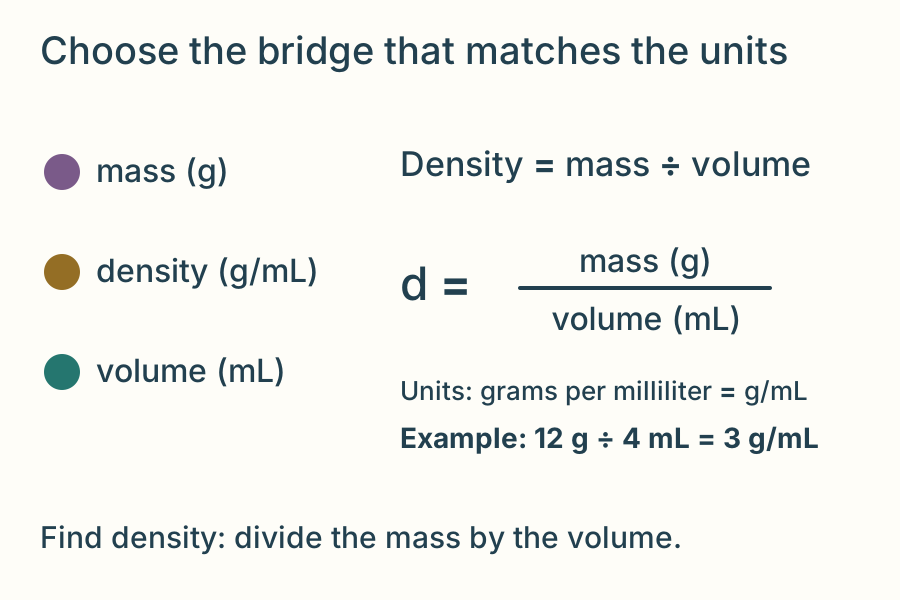
g/mL
g/mol
| Zero | Significant? | Example |
|---|---|---|
| Leading | No | 0.00450 → 3 sig figs |
| Between nonzero digits | Yes | 105 → 3 sig figs |
| Trailing, after a decimal point | Yes | 2.50 → 3 sig figs (2.5 has 2) |
| Trailing in a whole number | Unclear | Use scientific notation: 1.50 × 10³ has 3 |
| Operation | Keep | Example |
|---|---|---|
| × or ÷ | Fewest sig figs in measured inputs | 54.0 g ÷ 20.0 mL = 2.70 g/mL |
| + or − | Least precise decimal place | 12.11 + 1.2 = 13.3 |
| Exact counts, defined conversions | Never limit precision | 1 L = 1000 mL |
| Task | Rule | Example |
|---|---|---|
| Write | Count decimal places moved. ≥ 10: positive exponent; 1 to under 10: zero; below 1: negative | 0.00450 = 4.50 × 10⁻³ |
| Multiply | Multiply coefficients, add exponents | (2.0 × 10³)(3.0 × 10⁴) = 6.0 × 10⁷ |
| Divide | Divide coefficients, subtract exponents | 8.0 × 1062.0 × 102 = 4.0 × 10⁴ |
| Fix | Coefficient under 1 or ≥ 10? Shift it, adjust exponent | 12 × 105 = 1.2 × 10⁶ |
| Add or subtract | Match exponents first | 3.0 × 10⁴ + 0.20 × 104 = 3.2 × 10⁴ |
- Calculator: use the EE or EXP key (6.02 EE 23). It keeps the number together, so dividing by it works.
- Write the relation: d = mass ÷ volume.
- Substitute with units and cancel them.
- Count significant figures in the measured inputs.
- Round the final answer by the operation’s rule.
On the periodic table: Periodic-table masses follow the same zero rules: oxygen’s 16.00 has four significant figures.
A metal block has a mass of 54.0 g and a volume of 20.0 mL. Find its density. Then find the mass of 5.00 mL of the same metal.
- 1Write the relation
g/mL tells you mass goes on top.
d = massvolume - 2Substitute
Both inputs have 3 significant figures, so the answer keeps 3.
d = 54.0 g20.0 mL = 2.70 g/mL54.0 g 20.0 mL 2.70 g/mL 3 sig figs 3 sig figs 3 sig figs - 3Rearrange for mass
mL cancels, leaving g.
mass = d × V2.70 g1mL× 5.00mL= 13.5 g - ✓Answer
2.70 g/mL and 13.5 g
Calculate (4.0 × 10−3) × (3.0 × 105).
- 1Multiply the coefficients
They multiply like ordinary numbers.
4.0 × 3.0 = 12 - 2Add the exponents
Multiplying powers of 10 adds their exponents.
10−3 × 105 = 10−3 + 5 = 102so 12 × 102 - 3Fix the coefficient
Keep it from 1 to under 10. One place left adds 1 to the exponent.
12 × 102 = 1.2 × 10³ - ✓Answer
1.2 × 10³, two significant figures like the inputs
Section practice · 13 questions · tap to open
What this set is for: practicing the method from this section while it’s fresh. Every problem uses only what this section has taught.
Practice 1
A sample has mass 12.0 g and volume 4.0 mL. Find density.
Give me a hint
Put mass above volume.
Check the answer
Answer: 3.0 g/mL
Explain the worked problem to me
What you know: mass = 12.0 g, volume = 4.0 mL. What you want: density in g/mL.
- The unit g/mL tells you mass goes on top: d = mass ÷ volume.
- Divide: 12.0 g ÷ 4.0 mL = 3.0 g/mL.
- Round: this is division. 12.0 has three significant figures and 4.0 has two. Keep the fewest, two. The answer is 3.0 g/mL.
Check: Reverse it: 3.0 g/mL × 4.0 mL = 12.0 g.
Watch out: Writing 3.00 claims more precision than 4.0 has.
That’s right: 3.0 g/mL
Practice 2
A sample has mass 24.0 g and volume 8.0 mL. Find density.
Give me a hint
Put mass above volume.
Check the answer
Answer: 3.0 g/mL
Explain the worked problem to me
What you know: mass = 24.0 g, volume = 8.0 mL. What you want: density in g/mL.
- The unit g/mL tells you mass goes on top: d = mass ÷ volume.
- Divide: 24.0 g ÷ 8.0 mL = 3.0 g/mL.
- Round: this is division. 24.0 has three significant figures and 8.0 has two. Keep the fewest, two. The answer is 3.0 g/mL.
Check: Reverse it: 3.0 g/mL × 8.0 mL = 24.0 g.
Watch out: Writing 3.00 claims more precision than 8.0 has.
That’s right: 3.0 g/mL
Practice 3
A sample has mass 36.0 g and volume 12.0 mL. Find density.
Give me a hint
Put mass above volume.
Check the answer
Answer: 3.00 g/mL
Explain the worked problem to me
What you know: mass = 36.0 g, volume = 12.0 mL. What you want: density in g/mL.
- The unit g/mL tells you mass goes on top: d = mass ÷ volume.
- Divide: 36.0 g ÷ 12.0 mL = 3.00 g/mL.
- Round: this is division. 36.0 has three significant figures and 12.0 has three. Keep the fewest, three. The answer is 3.00 g/mL.
Check: Reverse it: 3.00 g/mL × 12.0 mL = 36.0 g.
Watch out: Both inputs have three significant figures, so write 3.00, not just 3.
That’s right: 3.00 g/mL
Practice 4
A sample has mass 48.0 g and volume 16.0 mL. Find density.
Give me a hint
Put mass above volume.
Check the answer
Answer: 3.00 g/mL
Explain the worked problem to me
What you know: mass = 48.0 g, volume = 16.0 mL. What you want: density in g/mL.
- The unit g/mL tells you mass goes on top: d = mass ÷ volume.
- Divide: 48.0 g ÷ 16.0 mL = 3.00 g/mL.
- Round: this is division. 48.0 has three significant figures and 16.0 has three. Keep the fewest, three. The answer is 3.00 g/mL.
Check: Reverse it: 3.00 g/mL × 16.0 mL = 48.0 g.
Watch out: Both inputs have three significant figures, so write 3.00, not just 3.
That’s right: 3.00 g/mL
Practice 5
A sample has mass 60.0 g and volume 20.0 mL. Find density.
Give me a hint
Put mass above volume.
Check the answer
Answer: 3.00 g/mL
Explain the worked problem to me
What you know: mass = 60.0 g, volume = 20.0 mL. What you want: density in g/mL.
- The unit g/mL tells you mass goes on top: d = mass ÷ volume.
- Divide: 60.0 g ÷ 20.0 mL = 3.00 g/mL.
- Round: this is division. 60.0 has three significant figures and 20.0 has three. Keep the fewest, three. The answer is 3.00 g/mL.
Check: Reverse it: 3.00 g/mL × 20.0 mL = 60.0 g.
Watch out: Both inputs have three significant figures, so write 3.00, not just 3.
That’s right: 3.00 g/mL
Practice 6
Which has 3 significant figures: 0.00450 or 0.0045?
Give me a hint
Leading zeros never count. A trailing zero after the decimal point does count.
Check the answer
Answer: 0.00450
Explain the worked problem to me
What you know: Two numbers, 0.00450 and 0.0045. What you want: the one with three significant figures.
- Leading zeros are not significant. They only place the decimal point. So skip the "0.00" in both.
- 0.0045 leaves 4 and 5: two significant figures.
- 0.00450 leaves 4, 5 and a trailing zero after the decimal point. Trailing zeros after a decimal point count. That makes three. The answer is 0.00450.
Check: In scientific notation, 0.00450 = 4.50 × 10⁻³ (three digits) and 0.0045 = 4.5 × 10⁻³ (two digits).
Watch out: The final zero is not decoration. It tells you the measurement was precise to that place.
That’s right: 0.00450
Practice 7
Round 2.31 + 1.2 by the addition rule.
Give me a hint
For addition, keep the fewest decimal places among the inputs.
Check the answer
Answer: 3.5
Explain the worked problem to me
What you know: 2.31 + 1.2. What you want: the sum, rounded by the addition rule.
- Add first, keeping all digits: 2.31 + 1.2 = 3.51.
- For addition, look at decimal places, not significant figures. 2.31 goes to the hundredths place. 1.2 goes only to the tenths place.
- The least precise place is the tenths. Round 3.51 to the tenths: 3.5.
Check: 1.2 is unknown past the tenths, so the sum cannot be known past the tenths either.
Watch out: Do not count significant figures here. That rule is for multiplication and division.
That’s right: 3.5
Practice 8
Repeated readings cluster at 9.0 when the accepted value is 10.0. Precise or accurate?
Give me a hint
Precise means the readings agree with each other. Accurate means they match the accepted value.
Check the answer
Answer: Precise but inaccurate
Explain the worked problem to me
What you know: Readings cluster at 9.0; the accepted value is 10.0. What you want: precise, accurate, both, or neither.
- Precision means repeated results are close to one another. The readings cluster tightly, so they are precise.
- Accuracy means closeness to the accepted value. 9.0 is a full unit away from 10.0, so they are not accurate.
- The answer is precise but inaccurate.
Why it matters: A tight cluster in the wrong place often means a mistake built into the method, like a scale that reads low every time.
Watch out: Precise and accurate are not the same word. Agreeing with each other is not the same as being right.
That’s right: Precise but inaccurate
Practice 9
Does 1000 mL = 1 L limit significant figures?
Give me a hint
Exact counts and defined conversions never limit significant figures.
Check the answer
Answer: No
Explain the worked problem to me
What you know: 1000 mL = 1 L. What you want: whether this factor limits significant figures.
- Ask: is this number measured or defined? Nobody measured it. The prefix "milli" means one thousandth by definition.
- The rule says exact counts and defined conversions do not limit precision. They have unlimited significant figures.
- So the answer is No. Only your measured inputs decide how many figures to keep.
Why it matters: If you treated 1 L as one significant figure, every conversion would be rounded to one digit, which throws away real information.
That’s right: No
Practice 10
Find mass from density 2.0 g/mL and volume 5.0 mL.
Give me a hint
Mass = density × volume, so the mL units cancel.
Check the answer
Answer: 10 g (two significant figures)
Explain the worked problem to me
What you know: density = 2.0 g/mL, volume = 5.0 mL. What you want: mass in g.
- Rearrange d = mass ÷ volume to get mass alone: mass = density × volume.
- Multiply: 2.0 g/mL × 5.0 mL = 10 g. mL cancels, leaving g.
- Round: both inputs have two significant figures, so the answer has two. The answer is 10 g (two significant figures). Writing it as 1.0 × 101 g makes the two figures clear.
Check: Reverse it: 10 g ÷ 5.0 mL = 2.0 g/mL.
Watch out: A whole number ending in zero, like 10, hides whether the zero is significant. Scientific notation removes the doubt.
That’s right: 10 g (two significant figures)
Practice 11
Calculate (5.0 × 104) × (2.0 × 10−6).
Give me a hint
Multiply the coefficients, add the exponents, then fix the coefficient.
Check the answer
Answer: 1.0 × 10⁻¹
Explain the worked problem to me
What you know: (5.0 × 104) × (2.0 × 10−6). What you want: the product in scientific notation.
- Multiply the coefficients: 5.0 × 2.0 = 10.
- Add the exponents: 4 + (−6) = −2. So far: 10 × 10−2.
- Fix the coefficient. 10 is not less than 10, so move the decimal one place left and raise the exponent by 1: 1.0 × 10⁻¹. Keep two significant figures to match the inputs. The answer is 1.0 × 10⁻¹.
Check: 50000 × 0.000002 = 0.1, and 1.0 × 10−1 = 0.10.
Watch out: When you make the coefficient smaller, the exponent must go up, not down.
That’s right: 1.0 × 10⁻¹
Practice 12
Calculate (9.0 × 10⁸) ÷ (3.0 × 10³).
Give me a hint
Divide the coefficients and subtract the exponents.
Check the answer
Answer: 3.0 × 10⁵
Explain the worked problem to me
What you know: (9.0 × 10⁸) ÷ (3.0 × 10³). What you want: the quotient in scientific notation.
- Divide the coefficients: 9.0 ÷ 3.0 = 3.0.
- Subtract the exponents (top minus bottom): 8 − 3 = 5.
- 3.0 is already between 1 and 10, so no fixing is needed. Both inputs have two significant figures. The answer is 3.0 × 10⁵.
Check: Multiply back: (3.0 × 105) × (3.0 × 103) = 9.0 × 10⁸.
Watch out: Dividing exponents (8 ÷ 3) is wrong. For division, subtract them.
That’s right: 3.0 × 10⁵
Practice 13
Write 0.000720 in scientific notation.
Give me a hint
Move the decimal point until one nonzero digit is in front of it. The number is less than 1.
Check the answer
Answer: 7.20 × 10⁻⁴
Explain the worked problem to me
What you know: 0.000720. What you want: scientific notation, with a coefficient from 1 up to less than 10.
- Move the decimal point until one nonzero digit is in front of it: 0.000720 → 7.20. That is 4 places to the right.
- The original number is less than 1, so the exponent is negative: 10−4.
- Keep the significant figures. The leading zeros drop away, but the trailing zero after the decimal point counts. So keep 7.20. The answer is 7.20 × 10⁻⁴.
Check: 7.20 × 10⁻⁴ means move the decimal 4 places left: 0.000720.
Watch out: Writing 7.2 × 10⁻⁴ loses a significant figure.
That’s right: 7.20 × 10⁻⁴
0.4 Matter: elements, compounds, mixtures, and states
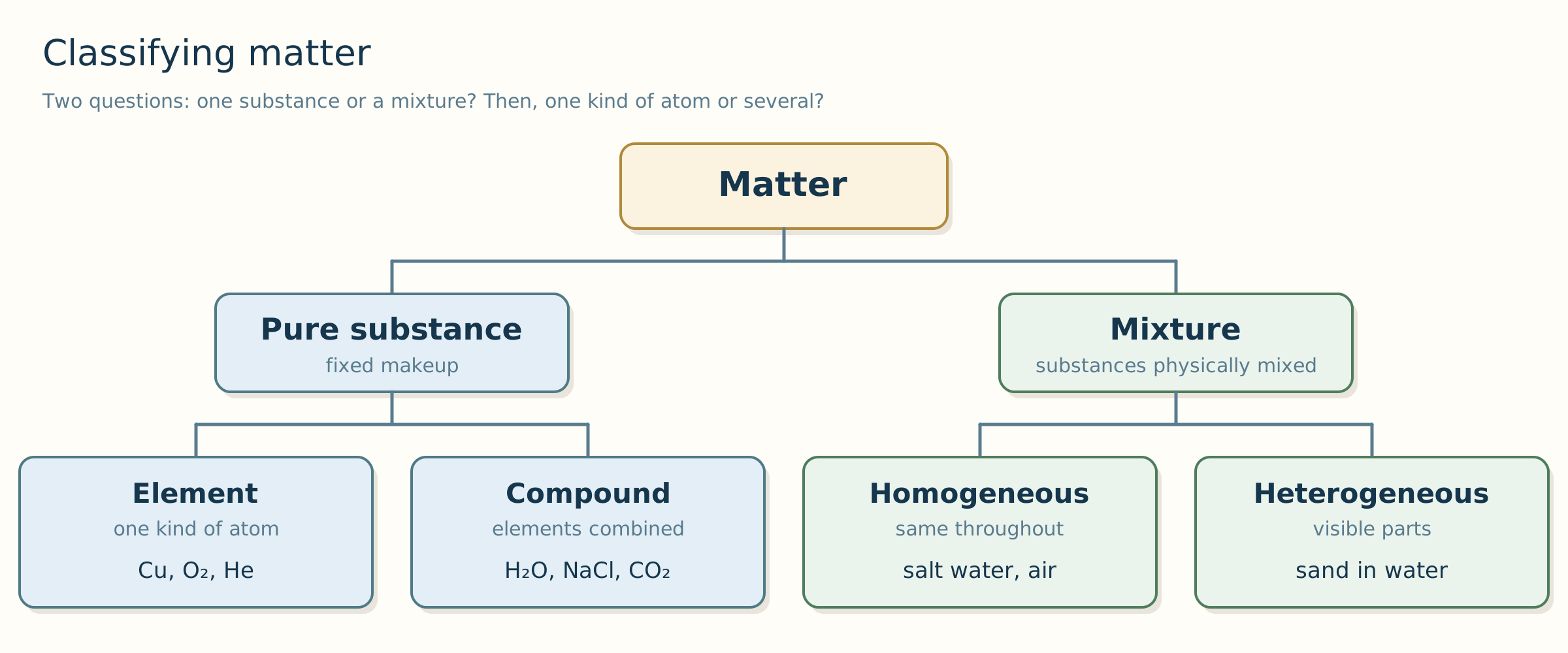
Matter is anything that has mass and takes up space. This lesson sorts matter into elements, compounds and mixtures. It also shows how particles behave in solids, liquids and gases.
| Term | Meaning | Example |
|---|---|---|
| Pure substance | Fixed makeup: an element or a compound | Copper, water |
| Element | One kind of atom | Copper (Cu), oxygen (O2) |
| Compound | Two or more elements chemically combined in a fixed ratio | Water (H2O) |
| Mixture | Two or more substances physically mixed. Each keeps its identity; amounts can vary. | Salt water, sand in water |
| Homogeneous mixture | Looks the same throughout. Also called a solution. | Salt water, air |
| Heterogeneous mixture | Visibly different parts | Sand in water, oil on water |
Element
Compound
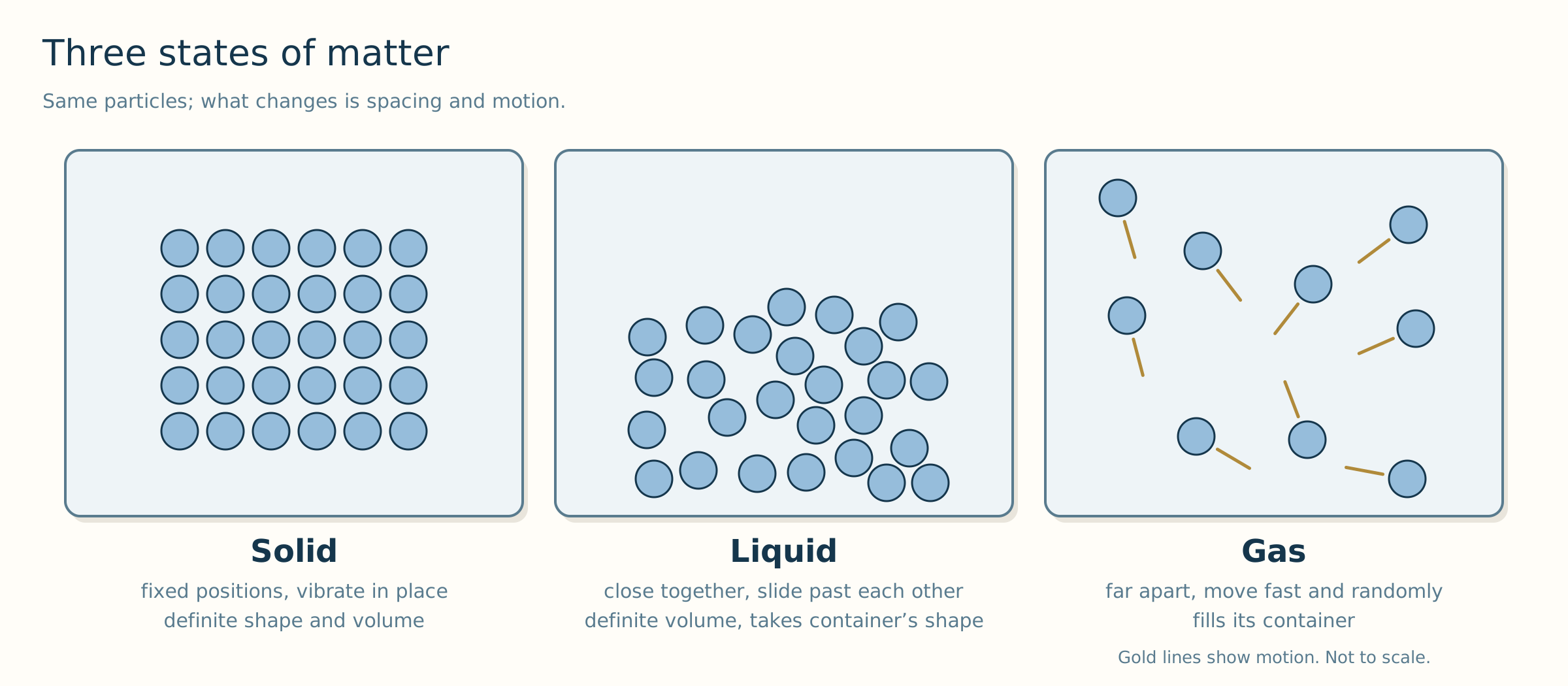
| State | Particles | Shape | Volume |
|---|---|---|---|
| Solid | Packed close in fixed positions; vibrate in place | Definite | Definite |
| Liquid | Close together but slide past one another | Takes the container’s shape | Definite |
| Gas | Far apart; move fast in random directions | None: fills the container | None: can be squeezed smaller |
- Ask: is it one substance, or several mixed together?
- One substance: one kind of atom (element) or several elements combined (compound)?
- Mixture: the same throughout (homogeneous) or visibly different parts (heterogeneous)?
On the periodic table: Every element has its own box and symbol on the periodic table, such as Fe for iron and Cu for copper. A formula built from one symbol is an element.
Classify each sample: iron (Fe), carbon dioxide (CO2), sugar dissolved in water, and oil with water.
- 1Iron, Fe
One element symbol: only one kind of atom.
Clue One symbol: Fe Class Element - 2Carbon dioxide, CO2
Two different elements chemically combined in a fixed ratio.
Clue Two symbols: C and O Class Compound - 3Sugar dissolved in water
Two substances, and it looks the same throughout.
Clue Two substances; looks the same throughout Class Homogeneous mixture - 4Oil with water
Two substances that stay in separate, visible layers.
Clue Two substances; visible layers Class Heterogeneous mixture - ✓Answer
Element, compound, homogeneous mixture, heterogeneous mixture
Section practice · 4 questions · tap to open
What this set is for: practicing the method from this section while it’s fresh. Every problem uses only what this section has taught.
Practice 1
Is table salt, NaCl, an element, a compound, or a mixture?
Give me a hint
Count the different element symbols in the formula.
Check the answer
Answer: A compound
Explain the worked problem to me
What you know: Table salt has the formula NaCl. What you want: element, compound, or mixture.
- A single chemical formula means a pure substance, not a mixture.
- Count the different element symbols: Na (sodium) and Cl (chlorine). That is two.
- Two or more different elements combined in a fixed ratio (here 1:1) make a compound.
Why it matters: Sodium and chlorine are combined chemically, so salt has its own properties, very different from either element alone.
Watch out: Two elements do not make a mixture when they share one formula. A mixture has no single formula.
That’s right: A compound
Practice 2
Is air a pure substance or a mixture? If it is a mixture, which kind?
Give me a hint
Air is mostly nitrogen and oxygen. Can you see separate parts?
Check the answer
Answer: A homogeneous mixture
Explain the worked problem to me
What you know: Air is mostly nitrogen (N2) and oxygen (O2). What you want: pure substance or mixture, and which kind.
- Ask: one substance or several? Air is several gases physically mixed. It has no single formula, and its makeup can vary, for example in humidity. So it is a mixture.
- Ask: can you see separate parts? No. Air looks the same throughout.
- A mixture that looks the same throughout is a homogeneous mixture.
Why it matters: Homogeneous mixtures are also called solutions. Air is a gas solution, just as salt water is a liquid one.
Watch out: N2 and O2 are each elements, but air contains both mixed together, so air itself is not an element.
That’s right: A homogeneous mixture
Practice 3
Which state has a definite volume but no definite shape?
Give me a hint
Think of pouring water into a different glass.
Check the answer
Answer: Liquid
Explain the worked problem to me
What you know: The state has a fixed volume but no fixed shape. What you want: which state.
- Picture pouring water into a different glass. The amount stays the same, but the shape changes to fit the glass.
- At the particle level, liquid particles stay close together, so the volume is fixed. They slide past one another, so they take the container's shape.
- That describes a liquid.
Why it matters: A solid keeps both its shape and volume. A gas keeps neither; it spreads to fill its container.
That’s right: Liquid
Practice 4
Why can a gas be squeezed into a smaller volume, but a solid cannot?
Give me a hint
Compare the space between particles.
Check the answer
Answer: Gas particles are far apart; solid particles are already touching.
Explain the worked problem to me
What you know: A gas can be squeezed; a solid cannot. What you want: the particle-level reason.
- Compare the space between particles. In a gas, particles are far apart with large empty gaps.
- Pushing on a gas closes those gaps, so the volume shrinks.
- In a solid, particles are already packed together and touching. There is almost no empty space to remove. So: gas particles are far apart; solid particles are already touching.
Why it matters: This is why gas tanks can hold a large amount of gas in a small space.
Watch out: Squeezing a gas does not make the particles smaller. It only shrinks the space between them.
That’s right: Gas particles are far apart; solid particles are already touching.
0.5 Changes, heat, and scientific methods
A physical change alters form; a chemical change makes new substances. Heat is energy that flows from hotter to colder, changing how fast particles move. Scientists test ideas against evidence in a repeating cycle.
Melting ice, boiling water, cutting paper, dissolving sugar.
Burning, rusting, cooking.
- Bubbles of a new gas
- A color change
- A solid forming when two solutions are mixed
- Light or heat given off
- A new odor
Color, density, melting point, boiling point.
Flammability, reactivity with acid, tendency to rust.
- Heat flowing in: particles speed up, or the substance changes state.
- Heat flowing out: particles slow down.
- Chapter 7 shows how to calculate heat.
| Term | Meaning |
|---|---|
| Observation | Noticing something. Qualitative describes (“the solution turned blue”). Quantitative measures, with a number and unit (“the mass was 2.50 g”). |
| Hypothesis | A testable explanation or prediction |
| Experiment | A controlled test that changes one variable (one factor, such as temperature) at a time |
| Analysis | Do the data support the hypothesis? If not, revise it and test again. |
Mass is conserved in a chemical reaction.
Atomic theory.
- Ask: is it still the same substance afterward?
- Look for chemical-change clues: new gas, color change, solid forming, light or heat, new odor.
- Same identity: physical. New substance: chemical.
Physical or chemical change? Ice melting, iron rusting, baking soda fizzing in vinegar, and salt dissolving in water.
- 1Ice melting
It is still H2O; only the state changes.
Clue H2O(s) → H2O(l): same substance Change Physical - 2Iron rusting
Iron becomes a new substance, iron oxide, with a new color.
Clue New substance, new color Change Chemical - 3Baking soda in vinegar
Bubbles of a new gas, CO2, form.
Clue Bubbles of a new gas Change Chemical - 4Salt dissolving in water
The salt is still there; evaporating the water gets it back.
Clue Salt recovered by evaporation Change Physical - ✓Answer
Physical, chemical, chemical, physical
Section practice · 5 questions · tap to open
What this set is for: practicing the method from this section while it’s fresh. Every problem uses only what this section has taught.
Practice 1
Is boiling point a physical or a chemical property?
Give me a hint
Does measuring it turn the substance into something new?
Check the answer
Answer: Physical
Explain the worked problem to me
What you know: Boiling point is a property. What you want: physical or chemical.
- Ask: does measuring it turn the substance into something new?
- When water boils, liquid water becomes water vapor. It is still H2O, only in a different state.
- A property you can measure without making a new substance is physical.
Why it matters: A chemical property, like flammability, can only be seen when the substance changes into something new.
Watch out: Bubbles in boiling water are water vapor, not a new gas. A change of state is a physical change.
That’s right: Physical
Practice 2
Wood burning: physical or chemical change?
Give me a hint
Look for new substances, heat, and light.
Check the answer
Answer: Chemical
Explain the worked problem to me
What you know: Wood is burning. What you want: physical or chemical change.
- Look for the clues of a chemical change: a new gas, a color change, light or heat given off, a new odor.
- Burning wood gives off heat and light, smoke and a new smell. It leaves ash, which is not wood.
- New substances form (carbon dioxide, water vapor and ash). That makes it a chemical change.
Why it matters: You cannot turn the ash and gases back into wood. Physical changes, like melting ice, are usually easy to reverse.
That’s right: Chemical
Practice 3
A cup of hot cocoa cools on the table. What happens to the motion of its particles?
Give me a hint
Which way does heat flow: into the cocoa or out of it?
Check the answer
Answer: They slow down on average.
Explain the worked problem to me
What you know: Hot cocoa cools on a table. What you want: what happens to its particles' motion.
- Heat flows from hotter to cooler. The cocoa is hotter than the room, so heat flows out of the cocoa.
- Temperature measures the average kinetic energy, the energy of motion, of the particles.
- A falling temperature means lower average kinetic energy. So the particles slow down on average.
Why it matters: Particles never stop moving. Cooling only lowers their average speed.
Watch out: "On average" matters. Some particles still move fast; the average speed drops.
That’s right: They slow down on average.
Practice 4
“If I add salt, the water will boil at a higher temperature.” Is this an observation, a hypothesis, or a law?
Give me a hint
Has it been tested yet, or is it a prediction?
Check the answer
Answer: A hypothesis
Explain the worked problem to me
What you know: The statement "If I add salt, the water will boil at a higher temperature." What you want: observation, hypothesis, or law.
- Ask: has it been tested yet? No. It says what will happen.
- An observation records what you saw. A law describes a pattern confirmed many times. A hypothesis is a testable explanation or prediction.
- This is a testable prediction, so it is a hypothesis.
Why it matters: The next step is an experiment. If the data do not support it, revise the hypothesis and test again.
Watch out: Wording like "If I do this, that will happen" predicts an untested result. That is a strong clue for a hypothesis.
That’s right: A hypothesis
Practice 5
Which explains why something happens: a scientific law or a theory?
Give me a hint
One describes; the other explains.
Check the answer
Answer: A theory
Explain the worked problem to me
What you know: Two kinds of scientific statement, laws and theories. What you want: the one that explains why.
- A scientific law describes what happens, often as a pattern or equation.
- A theory explains why it happens, and it is supported by many tests.
- So the one that explains is a theory.
Why it matters: In science, "theory" does not mean a guess. It is a well-tested explanation.
Watch out: A theory does not "grow up" into a law. They do different jobs: one explains, the other describes.
That’s right: A theory
Skill check: the chapter’s key skills
Try each fresh question without the worked examples. Record your first answer and whether you used a hint. Explain the route as well as the answer.
Skill check · 7 questions · tap to open
What this set is for: one question on each key skill from this chapter. Try each on your own, without hints, then mark how it went in the tracker below. A miss tells you which section to review.
Skill 1: Set up a conversion, cancel units, and calculate the wanted unit.
Convert 750 mL to L using 1000 mL = 1 L.
Give me a hint
Put mL on the bottom of the conversion factor so it cancels. A liter is bigger than a milliliter, so expect a smaller number.
Check the answer
750 × 1/1000 = 0.750 L; mL cancels.
Explain the worked problem to me
What you know: 750 mL, and 1000 mL = 1 L. What you want: liters.
- Put the unit you are removing, mL, underneath: 750 mL × (1 L / 1000 mL).
- mL cancels, leaving L. Divide: 750 ÷ 1000 = 0.750. The answer is 0.750 L.
Check: A liter is bigger than a milliliter, so the number should be smaller. 0.750 L × 1000 mL/L = 750 mL.
Watch out: If you multiply by 1000, the factor is upside down and mL does not cancel.
That’s right: 750 × 1/1000 = 0.750 L; mL cancels.
Skill 2: Isolate an unknown by applying the same operation to both sides.
Solve 4X = 28.
Give me a hint
4X means 4 × X. Undo multiplication with division.
Check the answer
Divide both sides by 4: X = 7.
Explain the worked problem to me
What you know: 4X = 28. What you want: X by itself.
- 4X means 4 × X. Undo multiplication with division.
- Divide both sides by 4: 4X ÷ 4 = 28 ÷ 4.
- Simplify: X = 7.
Check: Put 7 back in: 4 × 7 = 28. It works.
Watch out: Subtracting 4 (X = 24) is the wrong undo. The 4 multiplies X; it is not added.
That’s right: Divide both sides by 4: X = 7.
Skill 3: Use density to connect mass and volume, and round by the calculation rule.
A liquid has a density of 0.80 g/mL. What volume holds 12.0 g?
Give me a hint
Rearrange d = m ÷ V to get V by itself. Count the significant figures in 0.80.
Check the answer
15 mL
Explain the worked problem to me
What you know: density = 0.80 g/mL, mass = 12.0 g. What you want: volume in mL.
- Rearrange d = m ÷ V to get V alone: multiply both sides by V (d × V = m), then divide by d: V = m ÷ d.
- Calculate: 12.0 g ÷ 0.80 g/mL = 15 mL. Grams cancel, leaving mL.
- Round: this is division. 12.0 has three significant figures and 0.80 has two. Keep two. The answer is 15 mL.
Check: Reverse it: 0.80 g/mL × 15 mL = 12 g. Also, density is under 1, so the volume in mL should be bigger than the mass in g.
Watch out: Multiplying (12.0 × 0.80 = 9.6) gives g2/mL, not mL.
That’s right: 15 mL
Skill 4: Classify matter as an element, a compound, or a mixture, and describe solids, liquids, and gases at the particle level.
Classify each: neon (Ne), seawater, and glucose (C6H12O6).
Give me a hint
Count the kinds of element symbols, or ask whether several substances are mixed.
Check the answer
Answer: Neon is an element; seawater is a homogeneous mixture; glucose is a compound.
Explain the worked problem to me
What you know: neon (Ne), seawater, glucose (C6H12O6). What you want: element, compound, or mixture for each.
- Neon has a single formula with one kind of symbol, Ne. One kind of atom means an element.
- Glucose has a single formula with three different symbols: C, H and O. Different elements combined in a fixed ratio make a compound.
- Seawater has no single formula. It is water with dissolved salts, so it is a mixture. It looks the same throughout, so it is homogeneous. The answer is Neon is an element; seawater is a homogeneous mixture; glucose is a compound.
Watch out: Subscripts like the 6 and 12 count atoms. They do not change the number of different elements, which is still three.
That’s right: Neon is an element; seawater is a homogeneous mixture; glucose is a compound.
Skill 5: Tell physical from chemical changes and properties, explain heat in terms of particle motion, and describe how scientists test ideas.
A silver spoon darkens (tarnishes) in air. Is this a physical or a chemical change, and what clue tells you?
Give me a hint
Is the dark coating still silver?
Check the answer
Answer: Chemical; the dark color is a clue that a new substance, silver sulfide, formed.
Explain the worked problem to me
What you know: A silver spoon darkens in air. What you want: physical or chemical change, and the clue.
- Ask: is the dark coating still silver? No. Silver reacts with sulfur compounds in the air to make silver sulfide, a black solid.
- A color change is one of the clues for a chemical change, because it often signals a new substance.
- A new substance formed, so the answer is chemical; the dark color is a clue that a new substance, silver sulfide, formed.
Watch out: Not every color change is chemical. Here the black coating has a different formula from silver, so a new substance really formed.
That’s right: Chemical; the dark color is a clue that a new substance, silver sulfide, formed.
Skill 6: Read a metric prefix as a power of ten, and use it to convert between prefixed units and base units.
A vitamin D tablet contains 25 μg of vitamin D. What is that mass in grams? (1 μg = 10−6 g)
Give me a hint
Micro (μ) means 10−6. Put μg underneath, then write 25 × 10−6 in scientific notation.
Check the answer
Answer: 2.5 × 10⁻⁵ g
Explain the worked problem to me
What you know: 25 μg, and 1 μg = 10−6 g. What you want: grams.
- Read the prefix: micro (μ) is 10−6, so each μg is a millionth of a gram.
- Put μg underneath so it cancels: 25 μg × (10−6 g / 1 μg) = 25 × 10−6 g.
- Fix the coefficient: 25 = 2.5 × 101, and 1 + (−6) = −5. The answer is 2.5 × 10⁻⁵ g, two significant figures like 25.
Check: A microgram is far smaller than a gram, so the number in grams must be far smaller than 25. Reverse it: 2.5 × 10−5 g × (106 μg / 1 g) = 2.5 × 101 μg = 25 μg.
Watch out: Multiplying by 106 instead gives 2.5 × 10⁷, a huge number for a tablet, and μg would not cancel. The factor was upside down.
That’s right: 2.5 × 10⁻⁵ g
Skill 7: Calculate with numbers in scientific notation.
Calculate (6.0 × 10⁵) ÷ (1.5 × 10⁻²).
Give me a hint
Divide the coefficients, then subtract the exponents, top minus bottom. Subtracting −2 is the same as adding 2.
Check the answer
Answer: 4.0 × 10⁷
Explain the worked problem to me
What you know: (6.0 × 10⁵) ÷ (1.5 × 10⁻²). What you want: the quotient in scientific notation.
- Divide the coefficients: 6.0 ÷ 1.5 = 4.0.
- Subtract the exponents (top minus bottom): 5 − (−2) = 5 + 2 = 7.
- 4.0 is already at least 1 and less than 10, so no fixing is needed. Both inputs have two significant figures, so keep two. The answer is 4.0 × 10⁷.
Check: Multiply back: (4.0 × 107) × (1.5 × 10−2) = 6.0 × 10⁵. Also, dividing by a number smaller than 1 should give a bigger result.
Watch out: Writing 5 − 2 = 3 drops the minus sign and gives 4.0 × 10³, which is 10,000 times too small.
That’s right: 4.0 × 10⁷
What to do next
Mark each skill: “I can do it independently,” “I needed help,” or “I need another explanation.” Revisit the section with the same goal for any skill needing help, then try a different question. A successful first attempt is evidence of progress; one answer alone does not establish lasting mastery.
Final coming up?
Take the 70-question practice final
Modeled on standardized first-term general chemistry finals: 70 questions, 110 minutes. Timed or untimed. Full feedback on every question, plus your score by topic. The first 20 are free; the full final is $7.99 for 2 weeks.
Original ChemGem questions.