ChemGem

How to Calculate Density and Use Significant Figures (Step-by-Step, with Practice)

Density links mass to volume. Significant figures (sig figs) show how precise a measurement is. Scientific notation keeps big and small numbers readable.

Spot it, solve it, practice it: 4 steps, 1 worked example, 15 practice problems. Free, no account.

The route · 4 steps

  1. Write the relation: d = mass ÷ volume.
  2. Substitute with units and cancel them.
  3. Count significant figures in the measured inputs.
  4. Round the final answer by the operation’s rule.
Spot it

How to recognize density and sig fig questions

Look for mass and volume (density), questions about significant figures or rounding, precise vs. accurate, or numbers written with × 10 powers.

Example wording, with the clue words marked:

A sample has mass 12.0 g and volume 4.0 mL. Find density.

Not sure it’s this type? Compare the neighbors:

Step-by-step

Worked example: density and sig fig

The idea

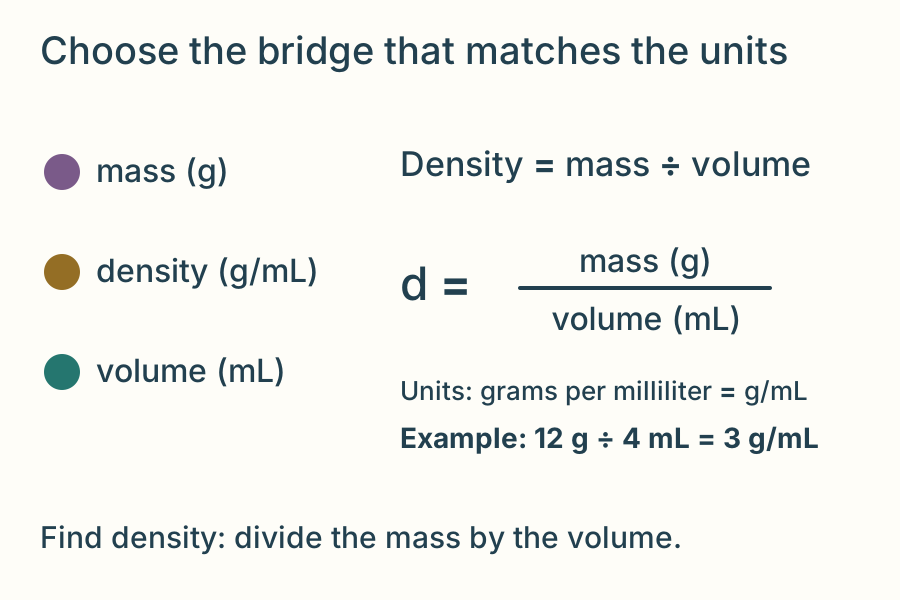
Density = mass ÷ volume
d = mass (g)volume (mL)
mass = d × V     V = massd
g/mL: mass on top, volume below.
Colored dots label mass (g), density (g/mL) and volume (mL). Beside them, density = mass ÷ volume is written as a fraction, with the example 12 g ÷ 4 mL = 3 g/mL.
The units show the setup.
Two different bridges
Density
grams ⇄ volume
g/mL
Molar mass
grams ⇄ moles
g/mol
Accuracy vs precision
Accurate and preciseon center, close togetherPrecise, not accurateclose together, off centerNeitherspread out, off center
Accuracy: close to the accepted value (center). Precision: repeats close together. A tight cluster can still be inaccurate.
Which zeros are significant?
ZeroSignificant?Example
LeadingNo0.00450 → 3 sig figs
Between nonzero digitsYes105 → 3 sig figs
Trailing, after a decimal pointYes2.50 → 3 sig figs (2.5 has 2)
Trailing in a whole numberUnclearUse scientific notation: 1.50 × 10³ has 3
Rounding by the calculation
OperationKeepExample
× or ÷Fewest sig figs in measured inputs54.0 g ÷ 20.0 mL = 2.70 g/mL
+ or −Least precise decimal place12.11 + 1.2 = 13.3
Exact counts, defined conversionsNever limit precision1 L = 1000 mL
Scientific notation: coefficient (1 to under 10) × power of 10
TaskRuleExample
WriteCount decimal places moved. ≥ 10: positive exponent; 1 to under 10: zero; below 1: negative0.00450 = 4.50 × 10⁻³
MultiplyMultiply coefficients, add exponents(2.0 × 10³)(3.0 × 10⁴) = 6.0 × 10⁷
DivideDivide coefficients, subtract exponents8.0 × 1062.0 × 102 = 4.0 × 10⁴
FixCoefficient under 1 or ≥ 10? Shift it, adjust exponent12 × 105 = 1.2 × 10⁶
Add or subtractMatch exponents first3.0 × 104 + 0.20 × 104 = 3.2 × 10⁴
  • Calculator: use the EE or EXP key (6.02 EE 23). It keeps the number together, so dividing by it works.

On the periodic table: Periodic-table masses follow the same zero rules: oxygen’s 16.00 has four significant figures.

Worked example · 3 steps

A metal block has a mass of 54.0 g and a volume of 20.0 mL. Find its density. Then find the mass of 5.00 mL of the same metal.

  1. 1
    Write the relation

    g/mL tells you mass goes on top.

    d = massvolume
  2. 2
    Substitute

    Both inputs have 3 significant figures, so the answer keeps 3.

    d = 54.0 g20.0 mL = 2.70 g/mL
    54.0 g20.0 mL2.70 g/mL
    3 sig figs3 sig figs3 sig figs
  3. 3
    Rearrange for mass

    mL cancels, leaving g.

    mass = d × V
    2.70 g1 mL × 5.00 mL = 13.5 g
  4. ✓
    Answer

    2.70 g/mL and 13.5 g

Your turn

Density and sig fig practice problems

Answer first, then check. Hints open one at a time; the answer and full solution open after you try.

Problem 1 of 15 · warm-up

A sample has mass 12.0 g and volume 4.0 mL. Find density.

Hint 1 · the clue

Put mass above volume.

Hint 2 · the next move

Mass and volume are given and density is asked for: divide mass by volume.

Your path:

  1. Use d = mass ÷ volume
  2. Divide g by mL
  3. Round to fewest sig figs
Answer

Answer: 3.0 g/mL

Full worked solution

What you know: mass = 12.0 g, volume = 4.0 mL. What you want: density in g/mL.

  1. The unit g/mL tells you mass goes on top: d = mass ÷ volume.
  2. Divide: 12.0 g ÷ 4.0 mL = 3.0 g/mL.
  3. Round: this is division. 12.0 has three significant figures and 4.0 has two. Keep the fewest, two. The answer is 3.0 g/mL.

Check: Reverse it: 3.0 g/mL × 4.0 mL = 12.0 g.

Watch out: Writing 3.00 claims more precision than 4.0 has.

Answer: 3.0 g/mL

Problem 2 of 15

A sample has mass 24.0 g and volume 8.0 mL. Find density.

Hint 1 · the clue

Put mass above volume.

Hint 2 · the next move

Mass and volume are given and density is asked for: divide mass by volume.

Your path:

  1. Use d = mass ÷ volume
  2. Divide g by mL
  3. Round to fewest sig figs
Answer

Answer: 3.0 g/mL

Full worked solution

What you know: mass = 24.0 g, volume = 8.0 mL. What you want: density in g/mL.

  1. The unit g/mL tells you mass goes on top: d = mass ÷ volume.
  2. Divide: 24.0 g ÷ 8.0 mL = 3.0 g/mL.
  3. Round: this is division. 24.0 has three significant figures and 8.0 has two. Keep the fewest, two. The answer is 3.0 g/mL.

Check: Reverse it: 3.0 g/mL × 8.0 mL = 24.0 g.

Watch out: Writing 3.00 claims more precision than 8.0 has.

Answer: 3.0 g/mL

Problem 3 of 15

A sample has mass 36.0 g and volume 12.0 mL. Find density.

Hint 1 · the clue

Put mass above volume.

Hint 2 · the next move

Mass and volume are given and density is asked for: divide mass by volume.

Your path:

  1. Use d = mass ÷ volume
  2. Divide g by mL
  3. Round to fewest sig figs
Answer

Answer: 3.00 g/mL

Full worked solution

What you know: mass = 36.0 g, volume = 12.0 mL. What you want: density in g/mL.

  1. The unit g/mL tells you mass goes on top: d = mass ÷ volume.
  2. Divide: 36.0 g ÷ 12.0 mL = 3.00 g/mL.
  3. Round: this is division. 36.0 has three significant figures and 12.0 has three. Keep the fewest, three. The answer is 3.00 g/mL.

Check: Reverse it: 3.00 g/mL × 12.0 mL = 36.0 g.

Watch out: Both inputs have three significant figures, so write 3.00, not just 3.

Answer: 3.00 g/mL

Problem 4 of 15

A sample has mass 48.0 g and volume 16.0 mL. Find density.

Hint 1 · the clue

Put mass above volume.

Hint 2 · the next move

Mass and volume are given and density is asked for: divide mass by volume.

Your path:

  1. Use d = mass ÷ volume
  2. Divide g by mL
  3. Round to fewest sig figs
Answer

Answer: 3.00 g/mL

Full worked solution

What you know: mass = 48.0 g, volume = 16.0 mL. What you want: density in g/mL.

  1. The unit g/mL tells you mass goes on top: d = mass ÷ volume.
  2. Divide: 48.0 g ÷ 16.0 mL = 3.00 g/mL.
  3. Round: this is division. 48.0 has three significant figures and 16.0 has three. Keep the fewest, three. The answer is 3.00 g/mL.

Check: Reverse it: 3.00 g/mL × 16.0 mL = 48.0 g.

Watch out: Both inputs have three significant figures, so write 3.00, not just 3.

Answer: 3.00 g/mL

Problem 5 of 15

A sample has mass 60.0 g and volume 20.0 mL. Find density.

Hint 1 · the clue

Put mass above volume.

Hint 2 · the next move

Mass and volume are given and density is asked for: divide mass by volume.

Your path:

  1. Use d = mass ÷ volume
  2. Divide g by mL
  3. Round to fewest sig figs
Answer

Answer: 3.00 g/mL

Full worked solution

What you know: mass = 60.0 g, volume = 20.0 mL. What you want: density in g/mL.

  1. The unit g/mL tells you mass goes on top: d = mass ÷ volume.
  2. Divide: 60.0 g ÷ 20.0 mL = 3.00 g/mL.
  3. Round: this is division. 60.0 has three significant figures and 20.0 has three. Keep the fewest, three. The answer is 3.00 g/mL.

Check: Reverse it: 3.00 g/mL × 20.0 mL = 60.0 g.

Watch out: Both inputs have three significant figures, so write 3.00, not just 3.

Answer: 3.00 g/mL

Problem 6 of 15

Which has 3 significant figures: 0.00450 or 0.0045?

Hint 1 · the clue

Leading zeros never count. A trailing zero after the decimal point does count.

Hint 2 · the next move

"Significant figures" in small decimals: apply the zero rules, skipping leading zeros and counting trailing zeros after a decimal.

Your path:

  1. Skip leading zeros; they only place decimal
  2. Count the remaining digits
  3. Trailing zeros after a decimal count
Answer

Answer: 0.00450

Full worked solution

What you know: Two numbers, 0.00450 and 0.0045. What you want: the one with three significant figures.

  1. Leading zeros are not significant. They only place the decimal point. So skip the "0.00" in both.
  2. 0.0045 leaves 4 and 5: two significant figures.
  3. 0.00450 leaves 4, 5 and a trailing zero after the decimal point. Trailing zeros after a decimal point count. That makes three. The answer is 0.00450.

Check: In scientific notation, 0.00450 = 4.50 × 10⁻³ (three digits) and 0.0045 = 4.5 × 10⁻³ (two digits).

Watch out: The final zero is not decoration. It tells you the measurement was precise to that place.

Answer: 0.00450

Problem 7 of 15

Round 2.31 + 1.2 by the addition rule.

Hint 1 · the clue

For addition, keep the fewest decimal places among the inputs.

Hint 2 · the next move

"Addition rule" signals rounding by decimal places, not by significant figures.

Your path:

  1. Add, keeping all digits
  2. Find the fewest decimal places
  3. Round the sum to that place
Answer

Answer: 3.5

Full worked solution

What you know: 2.31 + 1.2. What you want: the sum, rounded by the addition rule.

  1. Add first, keeping all digits: 2.31 + 1.2 = 3.51.
  2. For addition, look at decimal places, not significant figures. 2.31 goes to the hundredths place. 1.2 goes only to the tenths place.
  3. The least precise place is the tenths. Round 3.51 to the tenths: 3.5.

Check: 1.2 is unknown past the tenths, so the sum cannot be known past the tenths either.

Watch out: Do not count significant figures here. That rule is for multiplication and division.

Answer: 3.5

Problem 8 of 15

Repeated readings cluster at 9.0 when the accepted value is 10.0. Precise or accurate?

Hint 1 · the clue

Precise means the readings agree with each other. Accurate means they match the accepted value.

Hint 2 · the next move

Readings that cluster away from an accepted value signal a precision-versus-accuracy question.

Your path:

  1. Close to each other → precise
  2. Close to accepted value → accurate
  3. Judge each separately
Answer

Answer: Precise but inaccurate

Full worked solution

What you know: Readings cluster at 9.0; the accepted value is 10.0. What you want: precise, accurate, both, or neither.

  1. Precision means repeated results are close to one another. The readings cluster tightly, so they are precise.
  2. Accuracy means closeness to the accepted value. 9.0 is a full unit away from 10.0, so they are not accurate.
  3. The answer is precise but inaccurate.

Why it matters: A tight cluster in the wrong place often means a mistake built into the method, like a scale that reads low every time.

Watch out: Precise and accurate are not the same word. Agreeing with each other is not the same as being right.

Answer: Precise but inaccurate

Problem 9 of 15

Does 1000 mL = 1 L limit significant figures?

Hint 1 · the clue

Exact counts and defined conversions never limit significant figures.

Hint 2 · the next move

A defined unit equality is asked about sig figs: ask whether the number was measured or defined.

Your path:

  1. Ask: measured or defined?
  2. Defined by the prefix milli
  3. Exact numbers never limit sig figs
Answer

Answer: No

Full worked solution

What you know: 1000 mL = 1 L. What you want: whether this factor limits significant figures.

  1. Ask: is this number measured or defined? Nobody measured it. The prefix "milli" means one thousandth by definition.
  2. The rule says exact counts and defined conversions do not limit precision. They have unlimited significant figures.
  3. So the answer is No. Only your measured inputs decide how many figures to keep.

Why it matters: If you treated 1 L as one significant figure, every conversion would be rounded to one digit, which throws away real information.

Answer: No

Problem 10 of 15

Find mass from density 2.0 g/mL and volume 5.0 mL.

Hint 1 · the clue

Mass = density × volume, so the mL units cancel.

Hint 2 · the next move

Density and volume are given and mass is asked for: rearrange the density formula to mass = density × volume.

Your path:

  1. Rearrange: mass = density × volume
  2. Multiply; mL cancels, leaving g
  3. Round to fewest sig figs
Answer

Answer: 10 g (two significant figures)

Full worked solution

What you know: density = 2.0 g/mL, volume = 5.0 mL. What you want: mass in g.

  1. Rearrange d = mass ÷ volume to get mass alone: mass = density × volume.
  2. Multiply: 2.0 g/mL × 5.0 mL = 10 g. mL cancels, leaving g.
  3. Round: both inputs have two significant figures, so the answer has two. The answer is 10 g (two significant figures). Writing it as 1.0 × 101 g makes the two figures clear.

Check: Reverse it: 10 g ÷ 5.0 mL = 2.0 g/mL.

Watch out: A whole number ending in zero, like 10, hides whether the zero is significant. Scientific notation removes the doubt.

Answer: 10 g (two significant figures)

Problem 11 of 15

Calculate (5.0 × 104) × (2.0 × 10−6).

Hint 1 · the clue

Multiply the coefficients, add the exponents, then fix the coefficient.

Hint 2 · the next move

Two numbers in × 10 form are multiplied: multiply the coefficients and add the exponents.

Your path:

  1. Multiply the coefficients
  2. Add the exponents
  3. Fix coefficient to between 1 and 10
Answer

Answer: 1.0 × 10⁻¹

Full worked solution

What you know: (5.0 × 104) × (2.0 × 10−6). What you want: the product in scientific notation.

  1. Multiply the coefficients: 5.0 × 2.0 = 10.
  2. Add the exponents: 4 + (−6) = −2. So far: 10 × 10−2.
  3. Fix the coefficient. 10 is not less than 10, so move the decimal one place left and raise the exponent by 1: 1.0 × 10⁻¹. Keep two significant figures to match the inputs. The answer is 1.0 × 10⁻¹.

Check: 50000 × 0.000002 = 0.1, and 1.0 × 10−1 = 0.10.

Watch out: When you make the coefficient smaller, the exponent must go up, not down.

Answer: 1.0 × 10⁻¹

Problem 12 of 15

Calculate (9.0 × 10⁸) ÷ (3.0 × 10³).

Hint 1 · the clue

Divide the coefficients and subtract the exponents.

Hint 2 · the next move

Two numbers in × 10 form are divided: divide the coefficients and subtract the exponents.

Your path:

  1. Divide the coefficients
  2. Subtract exponents: top minus bottom
  3. Fix coefficient if needed
Answer

Answer: 3.0 × 10⁵

Full worked solution

What you know: (9.0 × 10⁸) ÷ (3.0 × 10³). What you want: the quotient in scientific notation.

  1. Divide the coefficients: 9.0 ÷ 3.0 = 3.0.
  2. Subtract the exponents (top minus bottom): 8 − 3 = 5.
  3. 3.0 is already between 1 and 10, so no fixing is needed. Both inputs have two significant figures. The answer is 3.0 × 10⁵.

Check: Multiply back: (3.0 × 105) × (3.0 × 103) = 9.0 × 10⁸.

Watch out: Dividing exponents (8 ÷ 3) is wrong. For division, subtract them.

Answer: 3.0 × 10⁵

Problem 13 of 15

Write 0.000720 in scientific notation.

Hint 1 · the clue

Move the decimal point until one nonzero digit is in front of it. The number is less than 1.

Hint 2 · the next move

"Scientific notation" for a number less than 1: move the decimal right, giving a negative exponent.

Your path:

  1. Move decimal after first nonzero digit
  2. Count the places moved
  3. Number < 1 → negative exponent
  4. Keep the trailing zero
Answer

Answer: 7.20 × 10⁻⁴

Full worked solution

What you know: 0.000720. What you want: scientific notation, with a coefficient from 1 up to less than 10.

  1. Move the decimal point until one nonzero digit is in front of it: 0.000720 → 7.20. That is 4 places to the right.
  2. The original number is less than 1, so the exponent is negative: 10−4.
  3. Keep the significant figures. The leading zeros drop away, but the trailing zero after the decimal point counts. So keep 7.20. The answer is 7.20 × 10⁻⁴.

Check: 7.20 × 10⁻⁴ means move the decimal 4 places left: 0.000720.

Watch out: Writing 7.2 × 10⁻⁴ loses a significant figure.

Answer: 7.20 × 10⁻⁴

Problem 14 of 15

A liquid has a density of 0.80 g/mL. What volume holds 12.0 g?

Hint 1 · the clue

Rearrange d = m ÷ V to get V by itself. Count the significant figures in 0.80.

Hint 2 · the next move

Density and mass are given and volume is asked for: rearrange density to V = mass ÷ density.

Your path:

  1. Rearrange: V = mass ÷ density
  2. Divide; grams cancel, leaving mL
  3. Round to fewest sig figs
Answer

15 mL

Full worked solution

What you know: density = 0.80 g/mL, mass = 12.0 g. What you want: volume in mL.

  1. Rearrange d = m ÷ V to get V alone: multiply both sides by V (d × V = m), then divide by d: V = m ÷ d.
  2. Calculate: 12.0 g ÷ 0.80 g/mL = 15 mL. Grams cancel, leaving mL.
  3. Round: this is division. 12.0 has three significant figures and 0.80 has two. Keep two. The answer is 15 mL.

Check: Reverse it: 0.80 g/mL × 15 mL = 12 g. Also, density is under 1, so the volume in mL should be bigger than the mass in g.

Watch out: Multiplying (12.0 × 0.80 = 9.6) gives g2/mL, not mL.

Answer: 15 mL

Problem 15 of 15

Calculate (6.0 × 10⁵) ÷ (1.5 × 10⁻²).

Hint 1 · the clue

Divide the coefficients, then subtract the exponents, top minus bottom. Subtracting −2 is the same as adding 2.

Hint 2 · the next move

Two numbers in × 10 form are divided: divide coefficients and subtract exponents (watch the negative exponent).

Your path:

  1. Divide the coefficients
  2. Subtract exponents: top minus bottom
  3. Minus a negative means add
Answer

Answer: 4.0 × 10⁷

Full worked solution

What you know: (6.0 × 10⁵) ÷ (1.5 × 10⁻²). What you want: the quotient in scientific notation.

  1. Divide the coefficients: 6.0 ÷ 1.5 = 4.0.
  2. Subtract the exponents (top minus bottom): 5 − (−2) = 5 + 2 = 7.
  3. 4.0 is already at least 1 and less than 10, so no fixing is needed. Both inputs have two significant figures, so keep two. The answer is 4.0 × 10⁷.

Check: Multiply back: (4.0 × 107) × (1.5 × 10−2) = 6.0 × 10⁵. Also, dividing by a number smaller than 1 should give a bigger result.

Watch out: Writing 5 − 2 = 3 drops the minus sign and gives 4.0 × 10³, which is 10,000 times too small.

Answer: 4.0 × 10⁷

Watch out

Common density and sig fig mistakes