ChemGem

How to Classify Matter: Elements, Compounds and Mixtures (Step-by-Step, with Practice)

Matter is anything that has mass and takes up space. This lesson sorts matter into elements, compounds and mixtures. It also shows how particles behave in solids, liquids and gases.

Spot it, solve it, practice it: 3 steps, 1 worked example, 5 practice problems. Free, no account.

The route · 3 steps

  1. Ask: is it one substance, or several mixed together?
  2. One substance: one kind of atom (element) or several elements combined (compound)?
  3. Mixture: the same throughout (homogeneous) or visibly different parts (heterogeneous)?
Spot it

How to recognize classifying matter questions

Look for "element, compound, or mixture," "pure substance," or a question about solids, liquids, and gases and how their particles behave.

Example wording, with the clue words marked:

Is table salt, NaCl, an element, a compound, or a mixture?

Not sure it’s this type? Compare the neighbors:

Step-by-step

Worked example: classifying matter

The idea

Kinds of matter
TermMeaningExample
Pure substanceFixed makeup: an element or a compoundCopper, water
ElementOne kind of atomCopper (Cu), oxygen (O2)
CompoundTwo or more elements chemically combined in a fixed ratioWater (H2O)
MixtureTwo or more substances physically mixed. Each keeps its identity; amounts can vary.Salt water, sand in water
Homogeneous mixtureLooks the same throughout. Also called a solution.Salt water, air
Heterogeneous mixtureVisibly different partsSand in water, oil on water
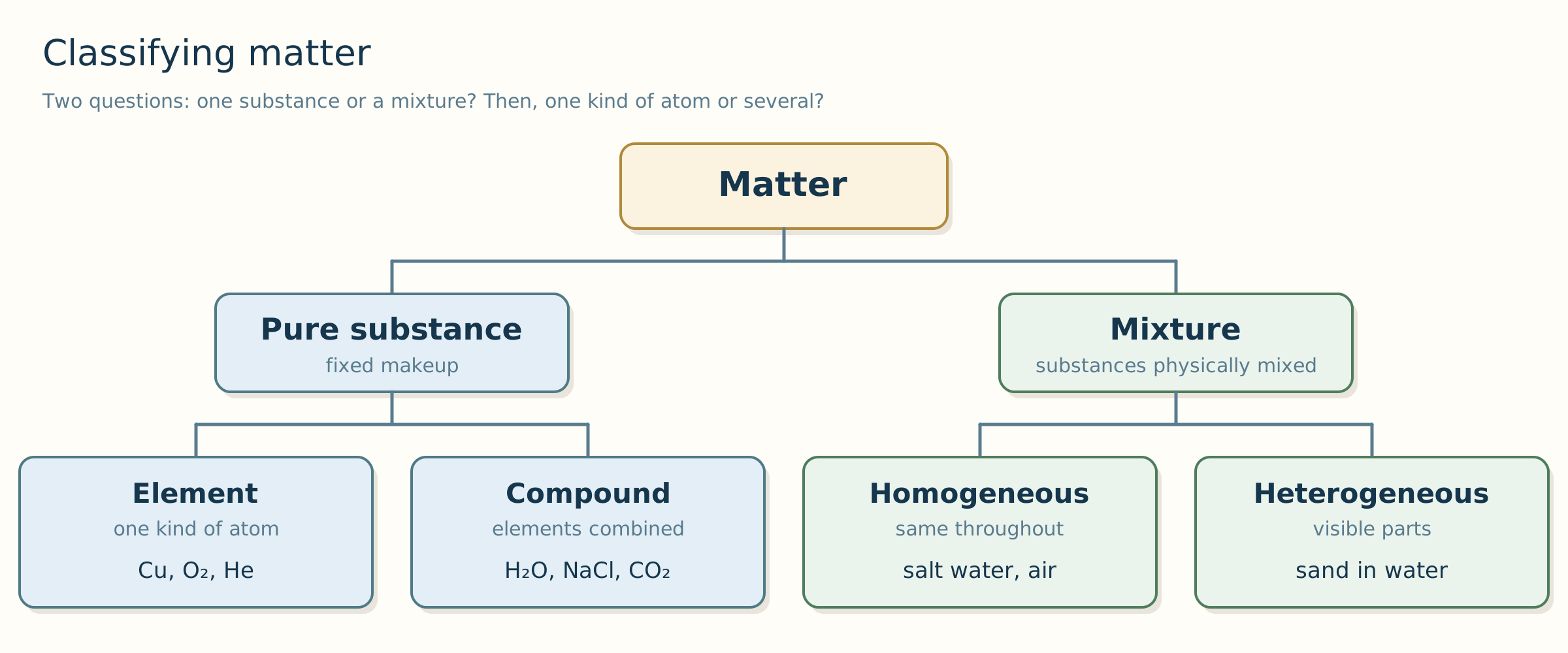
Matter splits into pure substances and mixtures. Pure substances are elements (one kind of atom) or compounds (elements combined in a fixed ratio). Mixtures are homogeneous (the same throughout) or heterogeneous (visibly different parts).
Ask two questions: one substance or several mixed? Then, one kind of atom or several combined?
The formula clue: a single formula means a pure substance
One kind of symbol
Fe, O2
Element
Two or more different symbols
NaCl, CO2
Compound
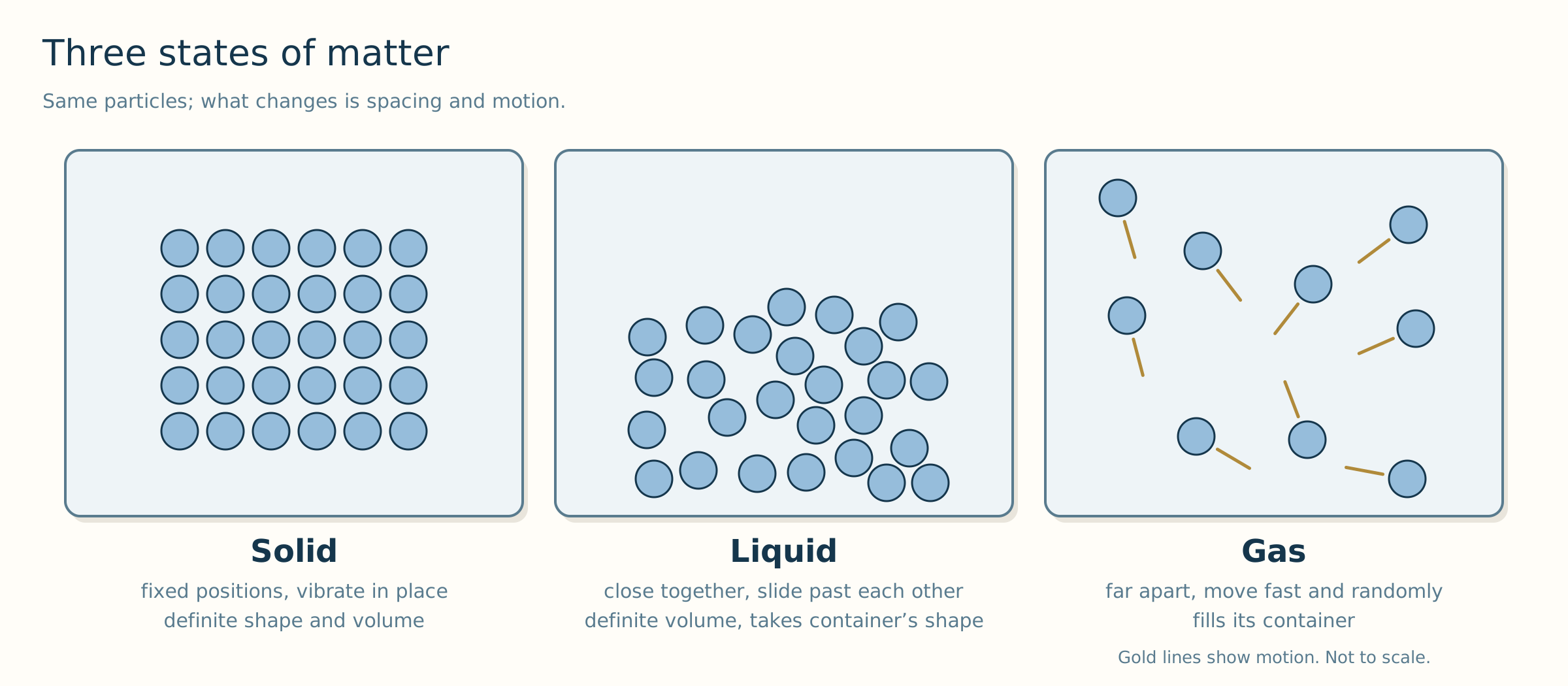
Particle views of a solid (packed in a regular pattern), a liquid (close together but disordered), and a gas (far apart, moving fast).
The same particles in three states. What changes is how close they are and how freely they move.
Three states of matter
StateParticlesShapeVolume
SolidPacked close in fixed positions; vibrate in placeDefiniteDefinite
LiquidClose together but slide past one anotherTakes the container’s shapeDefinite
GasFar apart; move fast in random directionsNone: fills the containerNone: can be squeezed smaller

On the periodic table: Every element has its own box and symbol on the periodic table, such as Fe for iron and Cu for copper. A formula built from one symbol is an element.

Worked example · 4 steps

Classify each sample: iron (Fe), carbon dioxide (CO2), sugar dissolved in water, and oil with water.

  1. 1
    Iron, Fe

    One element symbol: only one kind of atom.

    ClueOne symbol: Fe
    ClassElement
  2. 2
    Carbon dioxide, CO2

    Two different elements chemically combined in a fixed ratio.

    ClueTwo symbols: C and O
    ClassCompound
  3. 3
    Sugar dissolved in water

    Two substances, and it looks the same throughout.

    ClueTwo substances; looks the same throughout
    ClassHomogeneous mixture
  4. 4
    Oil with water

    Two substances that stay in separate, visible layers.

    ClueTwo substances; visible layers
    ClassHeterogeneous mixture
  5. ✓
    Answer

    Element, compound, homogeneous mixture, heterogeneous mixture

Your turn

Classifying matter practice problems

Answer first, then check. Hints open one at a time; the answer and full solution open after you try.

Problem 1 of 5 · warm-up

Is table salt, NaCl, an element, a compound, or a mixture?

Hint 1 · the clue

Count the different element symbols in the formula.

Hint 2 · the next move

A substance with one chemical formula is asked to be classified: count the different element symbols.

Your path:

  1. One formula → pure substance
  2. Count different element symbols
  3. Two or more → compound
Answer

Answer: A compound

Full worked solution

What you know: Table salt has the formula NaCl. What you want: element, compound, or mixture.

  1. A single chemical formula means a pure substance, not a mixture.
  2. Count the different element symbols: Na (sodium) and Cl (chlorine). That is two.
  3. Two or more different elements combined in a fixed ratio (here 1:1) make a compound.

Why it matters: Sodium and chlorine are combined chemically, so salt has its own properties, very different from either element alone.

Watch out: Two elements do not make a mixture when they share one formula. A mixture has no single formula.

Answer: A compound

Problem 2 of 5

Is air a pure substance or a mixture? If it is a mixture, which kind?

Hint 1 · the clue

Air is mostly nitrogen and oxygen. Can you see separate parts?

Hint 2 · the next move

"Pure substance or a mixture" and "which kind": ask if it has one formula, then if it looks uniform.

Your path:

  1. Air is several gases mixed
  2. No single formula → mixture
  3. Uniform throughout → homogeneous
Answer

Answer: A homogeneous mixture

Full worked solution

What you know: Air is mostly nitrogen (N2) and oxygen (O2). What you want: pure substance or mixture, and which kind.

  1. Ask: one substance or several? Air is several gases physically mixed. It has no single formula, and its makeup can vary, for example in humidity. So it is a mixture.
  2. Ask: can you see separate parts? No. Air looks the same throughout.
  3. A mixture that looks the same throughout is a homogeneous mixture.

Why it matters: Homogeneous mixtures are also called solutions. Air is a gas solution, just as salt water is a liquid one.

Watch out: N2 and O2 are each elements, but air contains both mixed together, so air itself is not an element.

Answer: A homogeneous mixture

Problem 3 of 5

Which state has a definite volume but no definite shape?

Hint 1 · the clue

Think of pouring water into a different glass.

Hint 2 · the next move

"Definite volume but no definite shape" signals matching a state of matter to its properties.

Your path:

  1. Fixed volume rules out gas
  2. Takes container's shape rules out solid
  3. Particles close but sliding → liquid
Answer

Answer: Liquid

Full worked solution

What you know: The state has a fixed volume but no fixed shape. What you want: which state.

  1. Picture pouring water into a different glass. The amount stays the same, but the shape changes to fit the glass.
  2. At the particle level, liquid particles stay close together, so the volume is fixed. They slide past one another, so they take the container's shape.
  3. That describes a liquid.

Why it matters: A solid keeps both its shape and volume. A gas keeps neither; it spreads to fill its container.

Answer: Liquid

Problem 4 of 5

Why can a gas be squeezed into a smaller volume, but a solid cannot?

Hint 1 · the clue

Compare the space between particles.

Hint 2 · the next move

"Why" a gas can be "squeezed" but a solid cannot asks for a particle-spacing explanation.

Your path:

  1. Compare space between particles
  2. Gas: far apart, gaps close when pushed
  3. Solid: particles already touching
Answer

Answer: Gas particles are far apart; solid particles are already touching.

Full worked solution

What you know: A gas can be squeezed; a solid cannot. What you want: the particle-level reason.

  1. Compare the space between particles. In a gas, particles are far apart with large empty gaps.
  2. Pushing on a gas closes those gaps, so the volume shrinks.
  3. In a solid, particles are already packed together and touching. There is almost no empty space to remove. So: gas particles are far apart; solid particles are already touching.

Why it matters: This is why gas tanks can hold a large amount of gas in a small space.

Watch out: Squeezing a gas does not make the particles smaller. It only shrinks the space between them.

Answer: Gas particles are far apart; solid particles are already touching.

Problem 5 of 5

Classify each: neon (Ne), seawater, and glucose (C6H12O6).

Hint 1 · the clue

Count the kinds of element symbols, or ask whether several substances are mixed.

Hint 2 · the next move

"Classify each" with symbols, a formula, and a natural sample: sort by formula and number of element types.

Your path:

  1. One symbol → element
  2. One formula, several symbols → compound
  3. No single formula, uniform → homogeneous mixture
Answer

Answer: Neon is an element; seawater is a homogeneous mixture; glucose is a compound.

Full worked solution

What you know: neon (Ne), seawater, glucose (C6H12O6). What you want: element, compound, or mixture for each.

  1. Neon has a single formula with one kind of symbol, Ne. One kind of atom means an element.
  2. Glucose has a single formula with three different symbols: C, H and O. Different elements combined in a fixed ratio make a compound.
  3. Seawater has no single formula. It is water with dissolved salts, so it is a mixture. It looks the same throughout, so it is homogeneous. The answer is Neon is an element; seawater is a homogeneous mixture; glucose is a compound.

Watch out: Subscripts like the 6 and 12 count atoms. They do not change the number of different elements, which is still three.

Answer: Neon is an element; seawater is a homogeneous mixture; glucose is a compound.

Watch out

Common classifying matter mistakes